


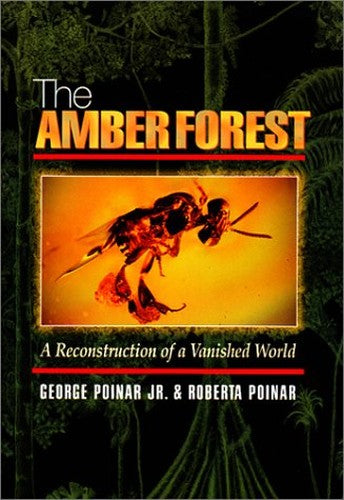
The Amber Forest by George Poinar Jr
In Jurassic Park, amber fossils provided the key to bringing dinosaurs back to life. Scientists in the movie extracted dinosaur blood from mosquitoes preserved for millions of years in amber - hardened tree resin - and used the blood's DNA to revive the creatures that terrified audiences around the globe. In this book, George and Roberta Poinar use amber for a similar act of revival - only they bring back an entire ecosystem. The Poinars are world leaders in the study of amber fossils and have spent years examining the uniquely rich supply that has survived from the ancient forests of the Dominican Republic. They draw on their research here to reconstruct in words, drawings, and spectacular color photographs the ecosystem that existed on the island of Hispaniola between fifteen and forty-five million years ago. The result is the most accurate picture scientists have yet produced of any tropical forest of the past. The specimens examined by the Poinars reflect amber's extraordinary qualities as a medium for preservation. Millions of years ago, countless plants, invertebrates, and small vertebrates were trapped in the sticky resin that flowed from the trees of ancient forests and, as that resin hardened into translucent, golden amber, they were preserved in almost perfect condition. Samples analyzed and illustrated here include a wide range of insects and plants - many now extinct - as well as such vertebrates as frogs, lizards, birds, and small mammals. There are even frozen scenes of combat: an assassin bug grappling with a stingless bee, for example, and a spider attacking a termite. By examining these plants and animals and comparing them to related forms that exist today, the authors shed new light on the behavior of these organisms as well as the environment and climate in which they lived and died. The Poinars present richly detailed drawings of how the forests once appeared. They discuss how and when life colonized Hispaniola and what caused some forms to become extinct. Along the way, they describe how amber is formed, how and where it has been preserved, and how it is mined, sold, and occasionally forged for profit today. The book is a beautifully written and produced homage to a remarkable, vanished world.
[The Poinars] have adroitly used the evidence provided by many small, fossilized objects to piece together a picture of the forestTheir specimens, trapped during life in resin from the forest's dominant algarrobo trees, are preserved in exquisite detail. They buttress their tale with an abundance of riveting photographs of denizens of that ancient forest. Scientific American Conventional paleontologists know dinosaurs and clams far better than they know caterpillars and fleas. The glorious thing about amber [is that it] does gentle justice to bees, wasps, spiders, ants and other fragile, important beings... The results can be so beautiful, so lapidary yet revealing, that amber science might be thought of as the field where paleontology crosses paths with jewelry... [An] amazing jewel box... The most intriguing aspect of the book, though, is not its stop-motion portraits of the little things that ran the ancient world, but the questions it raises about what became of them. -- David Quammen The New York Times Book Review Animal behavior is the high point of The Amber Forest... Since ants, bees, termites and ticks in these fossils are almost always close relations of organisms alive today, the Poinars are able to say a great deal about the ecology of the long-vanished forest itself. -- Jonathan Beard New Scientist [The authors'] descriptions of the interactions among the ancient biota are captivating. The text is richly complemented by 190 photographs and drawings by the authors, many depicting insects frozen in time. Publishers Weekly The authors have studied Dominican amber for many years, and their photographs and detailed drawings illuminate this fascinating summary of the forest's biota and paleoecology. Science The Poinars create for the reader a strangely realistic sense of what it is like to be one millimeter long and living in a forest of litter... This is classic natural history writing... with wonderful illustrations, including a section of color plates. Choice The Amber Forest reconstructs [a] 20 million-year-old ecosystem... With more than 200 photographs (most of them in colour) the authors walk the reader through this ancient rainforest... -- S. Blair Hedges Nature The great strength of The Amber Forest lies in revealing and explaining the intimate moments in the lives of long-vanished tiny creatures... The reader is constantly drawn to the tiny, the enigmatic, and the unexplained in these rich pages... Even a reader barely interested in the wonder of lost worlds can hardly fail to be moved by such images. -- Tim Flannery The New York Review of Books The Poinars are world leaders in the study of amber; their expertise and enthusiasm for amber are evident throughout the book. While very detailed, it is well written and a pleasure to read. The language is clear and scientific concepts are thoroughly explained so that all audiences can enjoy the book. -- Sara Lubkin American Paleontologist With more than 200 photographs ... the authors walk the reader through this ancient rainforest, describing a multitude of ecological interactions. -- S. Blair Hedges Nature The Amber Forest is a fine example of how growing numbers of professionals are making detailed scientific subjects interesting and understandable to lay readers. [It] reads like a novel and brings paleoentomolgy to life. -- Steve Voynick Rock & Gem The Amber Forest is a stunning book that should appeal to anyone with an interest in entomology, paleobiology, or the ecology of past and present tropical forests. Science Books and Films
George Poinar, Jr., is Professor Emeritus of Entomology at the University of California, Berkeley. He is currently on the faculty at Oregon State University, where he conducts research on amber deposits and biological inclusions in amber. He has written several books on amber, including, with Roberta Poinar. The Quest for Life in Amber. Roberta Poinar is an electron microscopist with experience in entomology and amber research. She and George Poinar led the international research effort to extract DNA from insects encased in amber.
| SKU | Nicht verfügbar |
| ISBN 13 | 9780691057286 |
| ISBN 10 | 0691057281 |
| Titel | The Amber Forest |
| Autor | George Poinar Jr |
| Buchzustand | Nicht verfügbar |
| Bindungsart | Paperback |
| Verlag | Princeton University Press |
| Erscheinungsjahr | 2001-09-24 |
| Seitenanzahl | 292 |
| Preise | Runner-up for AAP/Professional and Scholarly Publishing Awards: Biological Science 1999 |
| Hinweis auf dem Einband | Die Abbildung des Buches dient nur Illustrationszwecken, die tatsächliche Bindung, das Cover und die Auflage können sich davon unterscheiden. |
| Hinweis | Nicht verfügbar |