
The Anxieties of Affluence


Zusammenfassung
The feel-good place to buy books
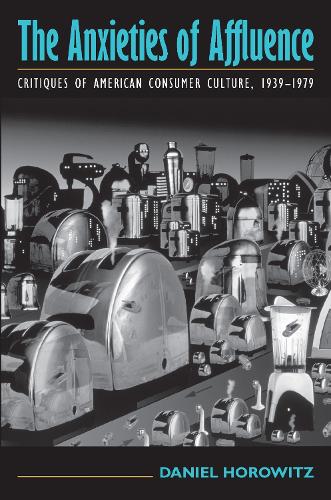
The Anxieties of Affluence by Daniel Horowitz
A wide-ranging exploration of conflicting American attitudes toward affluence This book charts the reactions of prominent American writers to the unprecedented prosperity of the decades following World War II. It begins with an examination of Lewis Mumford's war-time call for ""democratic"" consumption and concludes with an analysis of the origins of President Jimmy Carter's ""malaise"" speech of 1979. Between these bookends, Daniel Horowitz documents a broad range of competing views, each in its own way reflective of a deep-seated ambivalence toward consumer culture.
How - and why - have Americans struggled to make sense of consumption, morality, democracy, and capitalism? Horowitz elegantly and insightfully explores America's preeminent 20th-century answersWeaving influential ideas about consumption through the fabric of American social, cultural, economic, and political life, he carefully and clearly explains how each interacted with the others.... To the expected list of consumer culture critics that includes Lewis Mumford, Daniel Bell, Christopher Lasch, and Rachel Carson, Horowitz astutely adds such high-profile social activists as Betty Friedan and Martin Luther King Jr., and the manner in which appraisals of consumer culture shaped their thinking. Horowitz even provides a rare look at a political figure (President Jimmy Carter) engaging leading intellectuals while pondering his sense of national malaise due to crushing materialism. For balance, Horowitz includes thinkers who either celebrate consumption or accept it as natural and inevitable. A volume of exceptional accessibility and clarity. - Choice ""Magisterial, well-researched, and carefully nuanced.... Horowitz describes an era when Americans, and especially social scientists, believed in the notion of national character and mobilized it in various ways on behalf of arguments against hedonism, status-seeking, and self-fulfillment by means of indulgent consumption.... The Anxieties of Affluence is an essential book for social scientists and students of American culture."" - History: Reviews of New Books ""Horowitz deftly elucidates some of the most important works of the mid-twentieth century concerned with consumer abundance and its moral and political significance. The writing is always accessible, and the whole work offers a crystal clear overview and analysis of the meanings 'affluence' had in a crucial period of the past century."" - Howard Brick, author of Age of Contradiction: American Thought and Culture in the 1960s ""An impressive and important book.... In a field that is sometimes flooded with abstractions, Horowitz's approach - which focuses on specific people, debates, and texts - is welcome. There has been surprisingly little scholarship on post-World War II American consumer society, and this book certainly is the most thorough that I know of."" - Lawrence B. Glickman, author of A Living Wage: American Workers and the Making of Consumer Society
DANIEL HOROWITZ is Mary Huggins Gamble Professor of American Studies at Smith College and author of Betty Friedan and the Making of The Feminine Mystique: The American Left, the Cold War, and Modern Feminism.
| SKU | Nicht verfügbar |
| ISBN 13 | 9781558495043 |
| ISBN 10 | 1558495045 |
| Titel | The Anxieties of Affluence |
| Autor | Daniel Horowitz |
| Buchzustand | Nicht verfügbar |
| Bindungsart | Paperback |
| Verlag | University of Massachusetts Press |
| Erscheinungsjahr | 2005-09-30 |
| Seitenanzahl | 352 |
| Hinweis auf dem Einband | Die Abbildung des Buches dient nur Illustrationszwecken, die tatsächliche Bindung, das Cover und die Auflage können sich davon unterscheiden. |
| Hinweis | Nicht verfügbar |