
Aristotle's Poetics


Aristotle's Poetics
Regular price
Checking stock...
Regular price
Checking stock...
Zusammenfassung
George Whalley's English translation of the Poetics breathes new life into the study of Aristotle's aesthetics by allowing the English-speaking student to experience the dynamic quality characteristic of Aristotle's arguments in the original Greek.
The feel-good place to buy books
- Free delivery in the UK
- Supporting authors with AuthorSHARE
- 100% recyclable packaging
- B Corp - kinder to people and planet
- Buy-back with World of Books - Sell Your Books
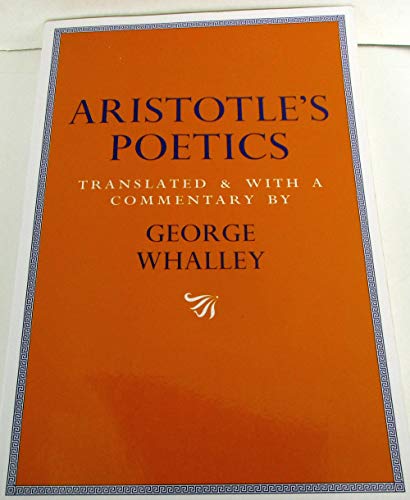
Aristotle's Poetics by Aristotle
Aristotle's Poetics combines a complete translation of the Poetics with a running commentary, printed on facing pages, that keeps the reader in continuous contact with the linguistic and critical subtleties of the original while highlighting crucial issues for students of literature and literary theory. Whalley's unconventional interpretation emphasizes Aristotle's treatment of art as dynamic process rather than finished product. The volume includes two essays by Whalley in which he outlines his method and purpose. He identifies a deep congruence between Aristotle's understanding of mimesis and Samuel Taylor Coleridge's view of imagination. Whalley's new translation makes a major contribution to the study of not only the Poetics and tragedy but all literature and aesthetics.
"Whalley has produced precisely the kind of volume that is needed if the Poetics is to be successfully and seriously taught at the college levelThis is the only edition of the Poetics that can truly claim to introduce adequately to a reader with no knowledge of Greek the problems and issues posed by the language of Aristotle's arguments. No current edition in use at the college level brings its readers to the same level of understanding of Aristotle's text that Whalley achieves in his translation and especially in his presentation of classical scholarship through the notes prepared for this edition." David Ferris, Department of Comparative Literature, Queens College and the Graduate School, City University of New York
ARISTOTLE was born in the northern Greek town of Stagira in 384 B.C.E., where his father was the personal physician to the great-grandfather of Alexander the Great. At the age of eighteen Aristotle entered Plato's Academy and soon became recognized as its most important student. He remained under Plato's tutelage for nearly twenty years. After his teacher's death in 347 B.C.E., Aristotle cultivated associations with other Academy students throughout Greece and Asia Minor. Then in 342 B.C.E., Aristotle was asked by King Philip II of Macedonia to become the tutor for his young son Alexander, who was later to become the conqueror of much of the known world at that time. The young prince remained under Aristotle's supervision until 336 B.C.E., when he acceded to the throne after his father's death. Two years later Aristotle returned to Athens and founded his own school, which he called the Lyceum. This intellectual center flourished during the years when Alexander the Great ruled Greece as part of his large empire. But upon Alexander's death in 323 B.C.E., Aristotle was charged with impiety by Athenians who resented his associations with the Macedonian conqueror. Rather than risk the same fate as Plato's mentor, Socrates, Aristotle fled to the city of Chalcis, where he died in 322 B.C.E. Aristotle's interests, like those of Plato, were diverse and his writing cast its shadow on many fields, including logic, metaphysics, epistemology, ethics, politics, and the sciences. Among his most well-known works are: The Categories, The Prior and Posterior Analytics, The Physics, The Meta-physics, De Anima, The Nicomachean Ethics, and The Politics.
| SKU | Nicht verfügbar |
| ISBN 13 | 9780773516120 |
| ISBN 10 | 0773516123 |
| Titel | Aristotle's Poetics |
| Autor | Aristotle |
| Buchzustand | Nicht verfügbar |
| Bindungsart | Paperback |
| Verlag | McGill-Queen's University Press |
| Erscheinungsjahr | 1997-10-24 |
| Seitenanzahl | 224 |
| Hinweis auf dem Einband | Die Abbildung des Buches dient nur Illustrationszwecken, die tatsächliche Bindung, das Cover und die Auflage können sich davon unterscheiden. |
| Hinweis | Nicht verfügbar |