


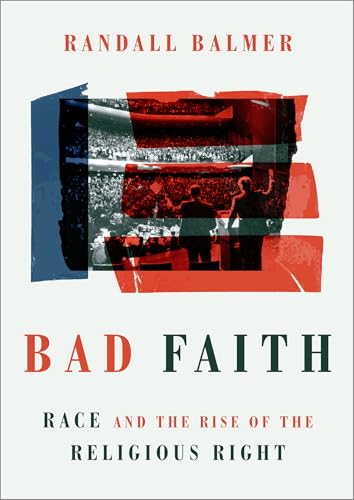
Bad Faith by Randall Balmer
A surprising and disturbing origin story
There is a commonly accepted story about the rise of the Religious Right in the United States. It goes like this: with righteous fury, American evangelicals entered the political arena as a unified front to fight the legality of abortion after the Supreme Court's 1973 Roe v. Wade decision.
The problem is this story simply isn't true.
Largely ambivalent about abortion until the late 1970s, evangelical leaders were first mobilized not by Roe v. Wade but by Green v. Connally, a lesser-known court decision in 1971 that threatened the tax-exempt status of racially discriminatory institutions--of which there were several in the world of Christian education at the time. When the most notorious of these schools, Bob Jones University, had its tax-exempt status revoked in 1976, evangelicalism was galvanized as a political force and brought into the fold of the Republican Party. Only later, when a more palatable issue was needed to cover for what was becoming an increasingly unpopular position following the civil rights era, was the moral crusade against abortion made the central issue of the movement now known as the Religious Right.
In this greatly expanded argument from his 2014 Politico article The Real Origins of the Religious Right, Randall Balmer guides the reader along the convoluted historical trajectory that began with American evangelicalism as a progressive force opposed to slavery, then later an isolated apolitical movement in the mid-twentieth century, all the way through the 2016 election in which 81 percent of white evangelicals coalesced around Donald Trump for president. The pivotal point, Balmer shows, was the period in the late 1970s when American evangelicals turned against Jimmy Carter--despite his being one of their own, a professed born-again Christian--in favor of the Republican Party, which found it could win their loyalty through the espousal of a single issue. With the implications of this alliance still unfolding, Balmer's account uncovers the roots of evangelical watchwords like religious freedom and family values while getting to the truth of how this movement began--explaining, in part, what it has become.
| SKU | Nicht verfügbar |
| ISBN 13 | 9780802879349 |
| ISBN 10 | 0802879349 |
| Titel | Bad Faith |
| Autor | Randall Balmer |
| Buchzustand | Nicht verfügbar |
| Bindungsart | Hardback |
| Verlag | William B Eerdmans Publishing Co |
| Erscheinungsjahr | 2021-08-10 |
| Seitenanzahl | 141 |
| Preise | Commended for Foreword INDIES Book of the Year Awards (Political/Social Sciences) 2021 |
| Hinweis auf dem Einband | Die Abbildung des Buches dient nur Illustrationszwecken, die tatsächliche Bindung, das Cover und die Auflage können sich davon unterscheiden. |
| Hinweis | Nicht verfügbar |