


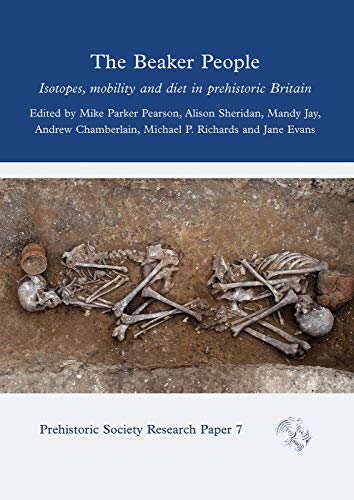
The Beaker People by Mike Parker Pearson
The Beaker People: Isotopes, Mobility and Diet in Prehistoric Britain presents the results of a major project that sought to address a century-old question about the people who were buried with Beakers a - the distinctive pottery of Continental origin that was current, predominantly in equally distinctive burials, in Britain from around 2450 BC. Who were these people? Were they immigrants and how far did they move around? What did they eat? What was their lifestyle? How do they compare with Britain's earlier inhabitants and with contemporaries who did not use Beaker pottery? An international team of leading archaeologists and scientists, led by Professor Mike Parker Pearson, was assembled to address these questions. Around 300 skeletons were subjected to isotope analysis to explore patterns of mobility and diet, and 150 new radiocarbon dates were obtained. Dental microwear was examined for 64 individuals to provide further information about the food they had eaten, and new information on the sex and age of 201 people obtained. A comparative study was undertaken of the shape and size of Beaker users' skulls and those of Neolithic people in the Peak District of England, to examine the long-held claim that there was a switch from long-headed to round-headed people with the appearance of Beakers. Tantalising evidence for head-binding among Neolithic people was found. The range of objects found in Beaker graves was reviewed. In addition, the Beaker People Project was able to incorporate the results of another project, focusing on Beaker users in north-east Scotland (The Beakers and Bodies Project) along with other recently obtained data, including ancient DNA results. Overall, new light has been shed on 369 people: 333 Beaker and non-Beaker users from the core 2500-1500 BC period, along with 17 from the Neolithic and 19 from after 1500 BC. While the genetic data provide convincing evidence for immigration by Continental Beaker users, the isotopic data indicate a more detailed picture of movements, mostly of fairly short distances within Britain, by the descendants of the first Beaker users. This lavishly illustrated book presents a body of data that will be vital to studies of Chalcolithic and Early Bronze Age Britain for decades to come.
[…]page numbers do not convey the scale of the work that went into it […] the data assembled here will be invaluable as the challenge continues * British Archaeology *
..this book is a highly valuable contribution to archaeological science. It presents material culture studies side-by-side with natural scientific studies for a successful integration of both domains to create an understanding of the big picture. The richness of the details and the background information provided is impressive. * Archaeologische Informationen *
[T]he books makes a transformative contribution to our understanding of Beaker people in Britain * Archaeological Journal *
Was it worth waiting? Yes. Are the results significant? Yes. Is the book worth acquiring? Yes. * Proceedings of the Prehistoric Society *
This 600-page edited volume...continues the tradition for weudite, well- and sensibly illustrated tomes, and it sells it short to say this is 'yet another' important book...This consummate volume […] provides the full 'Beaker Experience' that must guide/control the answer to that question: Who thought a few old bones could say so much? * Current Archaeology *
..this book is a highly valuable contribution to archaeological science. It presents material culture studies side-by-side with natural scientific studies for a successful integration of both domains to create an understanding of the big picture. The richness of the details and the background information provided is impressive. * Archaeologische Informationen *
[T]he books makes a transformative contribution to our understanding of Beaker people in Britain * Archaeological Journal *
Was it worth waiting? Yes. Are the results significant? Yes. Is the book worth acquiring? Yes. * Proceedings of the Prehistoric Society *
This 600-page edited volume...continues the tradition for weudite, well- and sensibly illustrated tomes, and it sells it short to say this is 'yet another' important book...This consummate volume […] provides the full 'Beaker Experience' that must guide/control the answer to that question: Who thought a few old bones could say so much? * Current Archaeology *
Mike Parker Pearson is Professor of British Later Prehistory at the Institute of Archaeology, University College London. A distinguished prehistorian, he has been involved with many major projects, including leading the recent Stonehenge Riverside Project. Alison Sheridan is emerita Principal Curator of Early Prehistory with National Museums Scotland and specialises in British and Irish Neolithic pottery and in the Neolithic period in this archipelago more generally. Mandy Jay is an Honorary Research Fellow in the Department of Archaeology, University of Durham where she specialises in the scientific study of isotopes and diet in prehistory. Andrew Chamberlain is Professor of Bioarchaeology at the University of Manchester. He specialises in the study of human remains from archaeological sites with research interests focusing on a range of questions in biological anthropology, science-based archaeology and palaeodemography. Mike Richards is a lecturer at the Simon Fraser University, Burnaby, Canada. His research interests include the evolution of human diets over time, especially the diets of Neanderthals and early modern humans, and the spread and adoption of agriculture in Eurasia. Current research includes developing new isotope systems for dietary and migration studies, using isotope analysis to explore and catalogue the range and nature of human dietary adaptations throughout the Holocene, and developing and applying isotope analysis in forensics. Jane Evans works for Worcester Archaeology and specialises in Roman pottery.
| SKU | Nicht verfügbar |
| ISBN 13 | 9781789250640 |
| ISBN 10 | 1789250641 |
| Titel | The Beaker People |
| Autor | Mike Parker Pearson |
| Serie | Prehistoric Society Research Papers |
| Buchzustand | Nicht verfügbar |
| Bindungsart | Hardback |
| Verlag | Oxbow Books |
| Erscheinungsjahr | 2019-03-31 |
| Seitenanzahl | 616 |
| Hinweis auf dem Einband | Die Abbildung des Buches dient nur Illustrationszwecken, die tatsächliche Bindung, das Cover und die Auflage können sich davon unterscheiden. |
| Hinweis | Nicht verfügbar |