


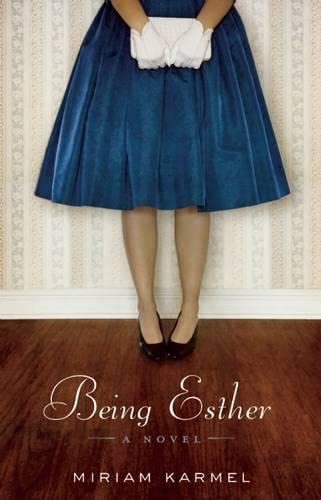
Being Esther by Miriam Karmel
Growing old is one of the most surprising things that has happened to her. She hadn't given it any thought. Then one day, she was eighty-five. She is old. Not just old, but an object of derision, pity. Is there any use explaining that she is still herself--albeit a slower, achier, creakier version of the original? --from Being Esther Born to parents who fled the shtetl, Esther Lustig has led a seemingly conventional life--marriage, two children, a life in suburban Chicago. Now, at the age of eighty-five, her husband is deceased, her children have families of their own, and most of her friends are gone. Even in this diminished condition, life has its moments of richness, as well as its memorable characters. But above all there are the memories. Of better days with Marty, her husband. Of unrealized obsessions with other men. As she moves back and forth through time, Esther attempts to come to terms with the meaning of her outwardly modest life. As a young woman, she wondered about the world beyond the narrow, prescribed world she inhabited. Now, cruelly, she can't help but wonder if she has done anything for which she will be remembered. At once sad and amusing, unpretentious yet wonderfully ambitious, Miriam Karmel's debut novel brings understanding and tremendous empathy to the unforgettable Esther Lustig. A journalist and freelance writer, Miriam Karmel has published writing in ARP The Magazine, Minnesota Women's Press, Bellevue Literary Review, and Minnesota Monthly. She lives in Minneapolis, Minnesota and Sandisfield, Massachusetts. Being Esther is her first novel.
Miriam Karmel has worked professionally as a newspaper reporter and magazine editor, and most recently as a freelance writer specializing in medicine and health. Her journalism has appeared in AARP magazine and for many years in Minnesota Women's Press. Her fiction has won numerous regional prizes, and her stories have been published in Bellevue Literary Review, Minnesota Monthly, as well as anthologized in Milkweed's Fiction on a Stick (2008). She lives in Minneapolis, MN and Sandisfield, MA. Being Esther is her first novel. Finding the right container by Miriam Karmel I've always been a writer. I produced my first awkward efforts on my parents' clunky old Royal. It was a heavy, metal machine with a black-and-red striped ribbon and fat, pearly keys. I couldn't yet read, but I loved pounding the keys, then ripping the paper from the roller and showing it off to my mother. I'd like to think that she praised me for all that gibberish. Or perhaps my random jottings were as remarkable as those of the chimpanzee who types Shakespeare by chance. What does it matter? Gibberish or Shakespeare, I loved putting words on paper. Later, I wrote letters to friends at summer camp. I was stuck at home with parents who didn't believe in camp, as if going away for the summer was a matter of faith. I entertained myself by writing what I believed were hilarious dispatches from the home front. I advanced to reporting for a newspaper, where I had a regular beat. And I wrote for magazines. Over the years, I've written op-ed pieces and essays, short stories and even poems, though I am not a poet. Being Esther began as a short story called Bingoville. It starts with a passage describing the way Esther and her friend Lorraine check in with each other every morning by phone. After I finished the story, I couldn't stop thinking about Esther. How does she spend her days? What does she eat for breakfast? What are her fears? What does she wear? What does she think about this thing or that? What did she do when she was young? I couldn't let go. Every story, fact or fiction, needs a container. Poets know that best. They seek a particular form to contain their words. Ode. Sonnet. Free verse. Sestina. Haiku. Or sometimes the poet adheres to a form as a way of opening up new possibilities or new territories for expression. Either way, form is chosen with intention. The story I wanted to tell, about an old woman coming to terms with the meaning of her life, felt right as fiction. Bingoville, the original Esther story, was contained in the short form. When I realized that I wasn't finished with Esther, I knew that I needed a larger container. I wrote a novel. I could have done otherwise. I could have interviewed gerontologists and psychologists, older people and the children of older people, then packaged all my findings into a magazine article, with some irksome title like, Growing Old Ain't for Sissies. The article might even begin with an anecdote about an older woman, like Esther, who calls a friend every morning to ensure that each has made it through another night. The article would go on to offer advice from experts on how to talk to mom about giving up the car keys or how to keep mom safe in her own home. There'd be a sidebar: 10 Tips for Staying Independent. That story would be practical and informative. But it wasn't the story I wanted to tell. I wanted to write about what it feels like to be old. I wanted to write about the struggle to maintain one's dignity as the body, and sometimes the mind, defeats us. I did research, of course. I read books on aging. I read the diaries of older women. I listened to friends' stories about how they were dealing with aging parents. Some of that found a way into Being Esther. I made it up! Being Esther is my invention. I don't know anyone exactly like Esther Lustig. And I don't know what it feels like to be very old. Fiction gave me the license to explore that feeling. I was free to inhabit the body of an old woman, to feel what it is like to be Esther. I've been asked how I came to fiction after a long career in journalism. I haven't at long last arrived at fiction. I simply chose to tell a story in a different form. Perhaps in my dotage, I'll be pounding the keys again, producing reams of gibberish. For now, it feels good to know that I could tell a story in novel form.
| SKU | Nicht verfügbar |
| ISBN 13 | 9781571310965 |
| ISBN 10 | 1571310967 |
| Titel | Being Esther |
| Autor | Miriam Karmel |
| Buchzustand | Nicht verfügbar |
| Verlag | Milkweed Editions |
| Erscheinungsjahr | 2013-03-19 |
| Seitenanzahl | 208 |
| Hinweis auf dem Einband | Die Abbildung des Buches dient nur Illustrationszwecken, die tatsächliche Bindung, das Cover und die Auflage können sich davon unterscheiden. |
| Hinweis | Nicht verfügbar |