
Dynamic Copula Methods in Finance


Zusammenfassung
The feel-good place to buy books
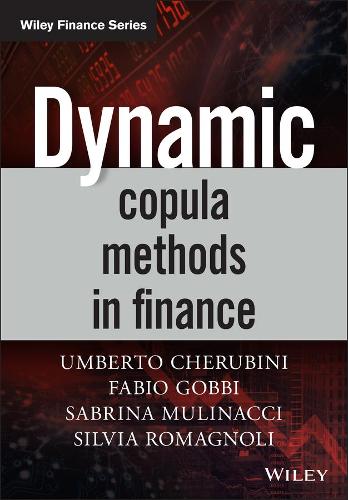
Dynamic Copula Methods in Finance by Umberto Cherubini
The latest tools and techniques for pricing and risk management This book introduces readers to the use of copula functions to represent the dynamics of financial assets and risk factors, integrated temporal and cross-section applications. The first part of the book will briefly introduce the standard the theory of copula functions, before examining the link between copulas and Markov processes. It will then introduce new techniques to design Markov processes that are suited to represent the dynamics of market risk factors and their co-movement, providing techniques to both estimate and simulate such dynamics. The second part of the book will show readers how to apply these methods to the evaluation of pricing of multivariate derivative contracts in the equity and credit markets. It will then move on to explore the applications of joint temporal and cross-section aggregation to the problem of risk integration.About the authors
UMBERTO CHERUBINI is Associate Professor of Financial Mathematics at the University of Bologna, where he heads the Graduate Degree in Quantitative Finance. He is a fellow of the Financial Econometrics Research Center (FERC), a member of the Scientific Committees of Abiformazione – the professional education arm of the Italian banking association, and AIFIRM – the Italian Association of Financial RiskManagers. He has been consulting and teaching in the field of finance and risk management for more than ten years. Before joining academia he worked as an economist at the Economic Research Department of BCI Milan. He has published papers in finance and economics in international journals, and is co-author of six books on topics of risk management and financial mathematics, including Fourier Transform Methods in Finance, John Wiley & Sons, Ltd, 2009; and Copula Methods in Finance, John Wiley & Sons, Ltd, 2004.
FABIO GOBBI is a post-doctoral researcher at the University of Bologna. He has a PhD in Statistics from the University of Florence and his areas of research focus on probability and financial econometrics. This is his first book.
SABRINA MULINACCI is Associate Professor of Mathematical Methods for Economics and Finance at the University of Bologna, Italy. Prior to this Sabrina was Associate Professor of Mathematical Methods for Economics and Actuarial Sciences at the Catholic University of Milan. She has a PhD in Mathematics from the University of Pisa and has published a number of research papers in international journals on probability and mathematical finance. She is co-author of Fourier Transform Methods in Finance, John Wiley & Sons, Ltd, 2009.
SILVIA ROMAGNOLI is Assistant Professor of Mathematical Models for Economics and Actuarial and Financial Sciences at the University of Bologna. Her scientific research is mainly addressed to the applications of stochastic models to finance and insurance. She has published several research papers in international journals on mathematical finance.
| SKU | Nicht verfügbar |
| ISBN 13 | 9780470683071 |
| ISBN 10 | 0470683074 |
| Titel | Dynamic Copula Methods in Finance |
| Autor | Umberto Cherubini |
| Serie | The Wiley Finance Series |
| Buchzustand | Nicht verfügbar |
| Verlag | John Wiley & Sons Inc |
| Erscheinungsjahr | 2011-10-28 |
| Seitenanzahl | 288 |
| Hinweis auf dem Einband | Die Abbildung des Buches dient nur Illustrationszwecken, die tatsächliche Bindung, das Cover und die Auflage können sich davon unterscheiden. |
| Hinweis | Nicht verfügbar |