
The Early History of the Law of Bills and Notes


The Early History of the Law of Bills and Notes
Regular price
Checking stock...
Regular price
Checking stock...
Zusammenfassung
This is a history of the law of bills and notes from medieval times to the late eighteenth and early nineteenth centuries when bills played a central role in domestic and international finances. It charts the development of legal rules and the relationship between law and economic and social controversies.
The feel-good place to buy books
- Free delivery in the UK
- Supporting authors with AuthorSHARE
- 100% recyclable packaging
- B Corp - kinder to people and planet
- Buy-back with World of Books - Sell Your Books
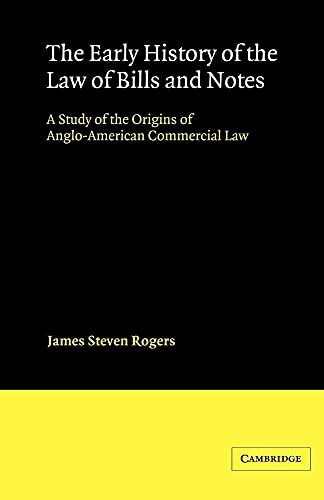
The Early History of the Law of Bills and Notes by James Steven Rogers
This study traces the history of the law of bills and notes in England from medieval times to the period in the late eighteenth and early nineteenth centuries when bills played a central role in the domestic and international financial system. It challenges the traditional theory that English commercial law developed by incorporation of the concept of negotiability and other rules from an ancient body of customary law known as the law merchant. Rogers shows that the law of bills was developed within the common law system itself, in response to changing economic and business practices. This account draws on economic and business history to explain how bills were actually used and to examine the relationship between the law of bills and economic and social controversies.
'This is a thoroughly absorbing and consistently illuminating book'Henry Roseveare, Business History
James Steven Rogers is Professor of Law at Boston College Law School, where he teaches commercial law, payment systems, and contracts. Professor Rogers has played a major role in the development of modern commercial law. He served as Reporter (principal drafter) for the Drafting Committee to Revise
UCC Article 8, which established a new legal framework for the modern system of electronic, book-entry securities holdings through central depositories and other intermediaries. He was also involved in the projects on negotiable instruments (UCC Articles 3 and 4) and secured transactions (UCC
Article 9). Professor Rogers is widely published in law reviews on subjects of modern commercial law and bankruptcy, particularly in the fields of investment securities, negotiable instruments, and the history of Anglo-American commercial law. He served as one of the United States delegates to the Hague
Conference on Private International Law project to negotiate and draft Convention on Choice of Law for Securities Holding through Securities Intermediaries and as a member of Drafting Group for that Convention. Prior joining the Boston College Law School faculty, James Steven Rogers practiced with
the firm of Sullivan & Worcester in Boston, Massachusetts and clerked for Judge Bailey Aldrich of the United States Court of Appeals for the First Circuit. He received a J.D. magna cum laude from Harvard Law School in 1976, where he served on the Harvard Law Review and was awarded the Fay Diploma
for graduating first in his class in cumulative G.P.A. He received his A.B. summa cum laude from the University of Pennsylvania, 1973, where he studied philosophy and history.
| SKU | Nicht verfügbar |
| ISBN 13 | 9780521522045 |
| ISBN 10 | 0521522048 |
| Titel | The Early History of the Law of Bills and Notes |
| Autor | James Steven Rogers |
| Serie | Cambridge Studies In English Legal History |
| Buchzustand | Nicht verfügbar |
| Bindungsart | Paperback |
| Verlag | Cambridge University Press |
| Erscheinungsjahr | 2004-12-23 |
| Seitenanzahl | 296 |
| Hinweis auf dem Einband | Die Abbildung des Buches dient nur Illustrationszwecken, die tatsächliche Bindung, das Cover und die Auflage können sich davon unterscheiden. |
| Hinweis | Nicht verfügbar |