
Electroshock


Electroshock
Regular price
Checking stock...
Regular price
Checking stock...
Zusammenfassung
Electroshock therapy (ECT) has long suffered from a controversial and bizarre public image. In this work, Max Fink draws on 45 years of clinical and research experience to argue that ECT is now a safe, effective, painless and sometimes life-saving treatment for emotional and mental disorders.
The feel-good place to buy books
- Free delivery in the UK
- Supporting authors with AuthorSHARE
- 100% recyclable packaging
- B Corp - kinder to people and planet
- Buy-back with World of Books - Sell Your Books
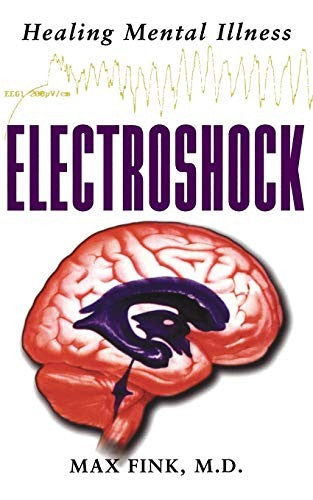
Electroshock by Max Fink Md Of Psychiatry And Neurology State University Of New York Stony Brook And Attending Psychiatrist Department Of Psychiatry Of Psychiatry And Neurology State University Of New York Stony Brook And Attending Psychiatrist Department Of Psychiatry Long Island Jewish-Hillside Hospital Medical Center)
Electroshock therapy (ECT) has long suffered from a controversial and bizarre public image, a reputation that has effectively removed it as a treatment option for many patients. In Electroshock, Max Fink draws on 45 years of clinical and research experience to argue that ECT is now a safe, effective, painless, and sometimes life-saving treatment for emotional and mental disorders. Dr Fink discusses the development of ECT from its discovery in 1934, its acceptance and widespread use for two decades until it was largely replaced by the introduction of psychotropic drugs in the 1950s, and its revival in the past twenty years as a viable treatment now that undesirable side-effects have been largely removed. He provides case studies of actual patients and the testimonies of their family members to illuminate successful responses. Many disorders, such as depression, mania, catatonia, and schizophrenia, respond well to ECT. We learn what the patient experiences, as the author explains the whole procedure from preparation to recovery. He also shows how anaesthesia and muscle relaxation have refined ECT, minimizing discomfort and reducing its risks to a level far lower than many of the psychotropic drugs routinely prescribed for the same problems. An excellent sourcebook for patients, their families, caretakers, and mental health professionals, Electroshock clarifies misconceptions about ECT. For those who suffer from mental and emotional disorders, it offers a safe and highly effective treatment.
In an America long besotted with psychotherapy, Max Fink carried an often lonely torch for the physical treatment of psychiatric disorders.. Electroshock is a slim volume, packing a punch of controversy. * Nature *
This book, clearly written, concise, and assertive, should help balance the picture, educating mental health professionals and the general public alike * Forward Magazine *
This book, clearly written, concise, and assertive, should help balance the picture, educating mental health professionals and the general public alike * Forward Magazine *
Max Fink, M.D., is Professor of Psychiatry and Neurology Emeritus at the State University of New York at Stony Brook and Attending Psychiatrist at the Long Island Jewish-Hillside Hospital Medical Center. He is the author of Convulsive Therapy: Theory and Practice, Psychobiology of Convulsive Therapy, and other books. He lives in Nissequogue, New York.
| SKU | Nicht verfügbar |
| ISBN 13 | 9780195158045 |
| ISBN 10 | 0195158040 |
| Titel | Electroshock |
| Autor | Max Fink Md Of Psychiatry And Neurology State University Of New York Stony Brook And Attending Psychiatrist Department Of Psychiatry Of Psychiatry And Neurology State University Of New York Stony Brook And Attending Psychiatrist Department Of Psychiatry Long Island Jewish-Hillside Hospital Medical Center) |
| Buchzustand | Nicht verfügbar |
| Bindungsart | Paperback |
| Verlag | Oxford University Press Inc |
| Erscheinungsjahr | 2002-12-19 |
| Seitenanzahl | 157 |
| Hinweis auf dem Einband | Die Abbildung des Buches dient nur Illustrationszwecken, die tatsächliche Bindung, das Cover und die Auflage können sich davon unterscheiden. |
| Hinweis | Nicht verfügbar |