
Equality and Partiality


Zusammenfassung
The feel-good place to buy books
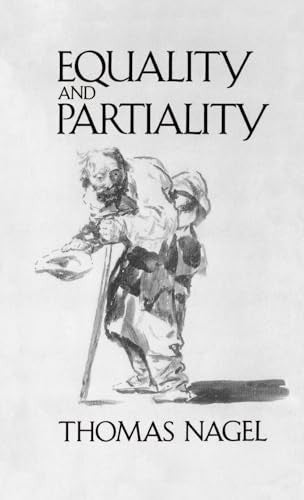
Equality and Partiality by Thomas Nagel
The conflict between the claims of the group and those of the individual is one of the most fundamental problems in moral and political theory. Nagel here attempts to clarify the nature of the conflict and to show that its reconciliation is the essential task of any legitimate political system. Within each individual, Nagel believes, there is a division between two standpoints, the personal and the impersonal. Without the impersonal standpoint, he says, there would be no morality, only the clash, compromise, and occasional convergence of individual perspectives. It is because a human being does not occupy only his own point of view that each one of us is susceptible to the claims of others through private and public morality. Political systems, to be legitimate, must achieve an integration of these two standpoints within the individual. Nagel contends that the problem of designing institutions that accomplish this has not yet been solved. Communism, which exalted the `impersonal' value of equality has clearly failed, but the individualism of democratic capitalism has perpetuated morally unacceptable levels of economic and social inequality. Nagel points to the problem of balancing equality and partiality as the most important issue with which political theorists are now faced. This book is based on Thomas Nagel's John Locke Lectures, delivered at Oxford early in 1990.
`combines a resolute psychological realism with a deep respect for the force of the claims which the reality of other people can and should make within every one of us' John Dunn, Times Higher Education Supplement
`Thomas Nagel is just about the most interesting philosopher of our day. Without descending to rhetorical tricks, he conveys a wonderful sense of the urgency of the issues he writes about ... deeply engrossing ... [his] deftness of touch and delicacy of intellectual imagination are exactly what the subject demands.' Alan Ryan, Times Literary Supplement
`If Nagel's Introduction takes the beginner to the frontier, his less pedagogical writings bring the subject back to basics: his whole oeuvre shows, par excellence, that what Morgenbesser says is true.' London Review of Books
'Thomas Nagel's new book is much more important than its brevity might suggest. Nagel pursues his enquiries with considerable imagination and flair: his book is immensely stimulating and a great pleasure to read.' John Horton, University ofYork, Political Studies (1991) XL
`masterful new book ... this is a book from which everyone can profit' The Philosophical Quarterly
`Thomas Nagel is just about the most interesting philosopher of our day. Without descending to rhetorical tricks, he conveys a wonderful sense of the urgency of the issues he writes about ... deeply engrossing ... [his] deftness of touch and delicacy of intellectual imagination are exactly what the subject demands.' Alan Ryan, Times Literary Supplement
`If Nagel's Introduction takes the beginner to the frontier, his less pedagogical writings bring the subject back to basics: his whole oeuvre shows, par excellence, that what Morgenbesser says is true.' London Review of Books
'Thomas Nagel's new book is much more important than its brevity might suggest. Nagel pursues his enquiries with considerable imagination and flair: his book is immensely stimulating and a great pleasure to read.' John Horton, University ofYork, Political Studies (1991) XL
`masterful new book ... this is a book from which everyone can profit' The Philosophical Quarterly
Thomas Nagel's previous Oxford books are: The View from Nowhere (1989), which sold nearly 4000 copies and What Does It All Mean? (1988, paperback 1989) which sold a total of nearly 11,000 copies.
| SKU | Nicht verfügbar |
| ISBN 13 | 9780195069679 |
| ISBN 10 | 0195069676 |
| Titel | Equality and Partiality |
| Autor | Thomas Nagel |
| Buchzustand | Nicht verfügbar |
| Verlag | Oxford University Press Inc |
| Erscheinungsjahr | 1991-11-14 |
| Seitenanzahl | 208 |
| Hinweis auf dem Einband | Die Abbildung des Buches dient nur Illustrationszwecken, die tatsächliche Bindung, das Cover und die Auflage können sich davon unterscheiden. |
| Hinweis | Nicht verfügbar |