


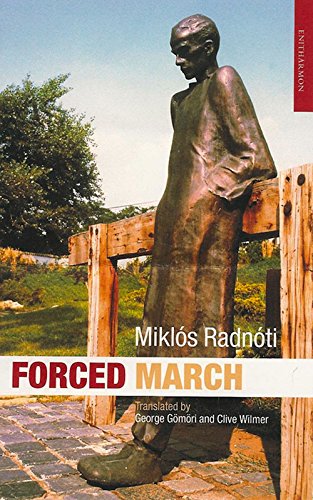
Forced March by Clive Wilmer
Forced March is a new edition of Radnoti s selected poems, in the powerful and moving translations of Clive Wilmer and George Gomori. Poet Dick Davis explains why this book is so important: Radnoti has emerged as the major poetic voice to record the civilian experience of World War I in occupied Europe. His poems are an extraordinary record of a mind determined to affirm its civilization in the face of overwhelming odds. He is one of the very greatest poets of the twentieth century, and Clive Wilmer s and George Gomori s versions are by far the best that exist in English. By the time the Second World War broke out, Miklos Radnoti was already an established poet. When the Nazis took over his home-town of Budapest, Radnoti was sent to a labour camp at Bor in occupied Serbia. Then, in 1944, as the Germans retreated from the eastern front, Radnoti and his fellow labourers were force-marched back into Hungary. On 9 November, too weak to carry on, he and many comrades were executed by firing-squad. When the bodies were exhumed the following year, Radnoti was identified by a notebook of poems in his greatcoat pocket. These poems, published in 1946 as Foaming Sky, secured his position as one of the giants of modern Hungarian poetry.
Miklos Radnoti, one of the giants of modern Hungarian poetry, was born in Budapest in 1909. He was of Jewish extraction. Orphaned early in life, he knew little emotional security till his 1935 marriage to Fanni Gyarmati, the muse of his poems. His first book of poetry, A Pagan Welcome, was published in 1930, when he was 21. It consists of celebrations of life and love, naive, formless and avant-garde in manner. Later volumes show the influence, first, of libertarian Socialism and, then, of Roman Catholicism. Radnoti's real talent does not emerge, however, till his fifth book, Keep Walking, You, the Death-Condemned (1936), where it is focused by his rising anxiety at the rise of fascism. This book and Steep Path (1938) reveal his growing preoccupation with fate and the deaths of poets in their youth. The latter also includes the first two of his eclogues in classical metres. From 1940 on, with Hungary in the shadow of the Third Reich, Radnoti, like many others of Jewish race, was obliged to serve in forced labour battalions. The last of these - at Bor in Serbia - was evacuated in 1944 as the Germans retreated from the eastern front. Radnoti and his fellow labourers were force-marched back into Hungary, where on 9 November, too weak to carry on, he and many comrades were executed by firing-squad. The following year the bodies were exhumed. Radnoti's was identified by a notebook of poems in his greatcoat pocket. They were published in 1946 under the title Foaming Sky.
| SKU | Nicht verfügbar |
| ISBN 13 | 9781900564533 |
| ISBN 10 | 190056453X |
| Titel | Forced March |
| Autor | Clive Wilmer |
| Buchzustand | Nicht verfügbar |
| Bindungsart | Paperback |
| Verlag | Enitharmon Press |
| Erscheinungsjahr | 2003-08-01 |
| Seitenanzahl | 80 |
| Hinweis auf dem Einband | Die Abbildung des Buches dient nur Illustrationszwecken, die tatsächliche Bindung, das Cover und die Auflage können sich davon unterscheiden. |
| Hinweis | Nicht verfügbar |