


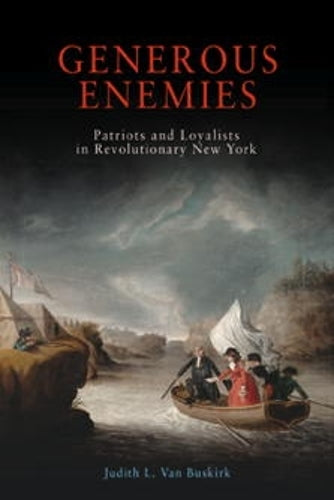
Generous Enemies by Judith L Van Buskirk
In July 1776, the final group of more than 130 ships of the Royal Navy sailed into the waters surrounding New York City, marking the start of seven years of British occupation that spanned the American Revolution. What military and political leaders characterized as an impenetrable "Fortress Britannia"—a bastion of solid opposition to the American cause—was actually very different. As Judith L. Van Buskirk reveals, the military standoff produced civilian communities that were forced to operate in close, sustained proximity, each testing the limits of political and military authority. Conflicting loyalties blurred relationships between the two sides: John Jay, a delegate to the Continental Congresses, had a brother whose political loyalties leaned toward the Crown, while one of the daughters of Continental Army general William Alexander lived in occupied New York City with her husband, a prominent Loyalist. Indeed, the texture of everyday life during the Revolution was much more complex than historians have recognized. Generous Enemies challenges many long-held assumptions about wartime experience during the American Revolution by demonstrating that communities conventionally depicted as hostile opponents were, in fact, in frequent contact. Living in two clearly delineated zones of military occupation—the British occupying the islands of New York Bay and the Americans in the surrounding countryside—the people of the New York City region often reached across military lines to help friends and family members, pay social calls, conduct business, or pursue a better life. Examining the movement of Loyalist and rebel families, British and American soldiers, free blacks, slaves, and businessmen, Van Buskirk shows how personal concerns often triumphed over political ideology. Making use of family letters, diaries, memoirs, soldier pensions, Loyalist claims, committee and church records, and newspapers, this compelling social history tells the story of the American Revolution with a richness of human detail."An engrossing account of wartime New York"—William and Mary Quarterly
"Well-written and engaging."—Choice
"A nicely written and well argued volume. . . . The book sheds light on how the ordinary as well as the extraordinary citizen dealt with the chaos and disruption brought by warfare, a lesson that concerns us to the present day."—American Historical Review
"In this wonderfully well-written book, Van Buskirk unearths a wealth of archival material to construct a compelling social history of a city at war. But instead of finding tales of bloodshed and betrayal, she finds that family bonds trumped partisan causes, personal concerns triumphed over political ideology, and commercial interests overrode military strategy. The lines between contending forces were porous, and the texture of everyday life in the city was much more complicated, she writes, than historians, and the public alike, have admitted."—Journal of American Studies
| SKU | Nicht verfügbar |
| ISBN 13 | 9780812218220 |
| ISBN 10 | 0812218221 |
| Titel | Generous Enemies |
| Autor | Judith L Van Buskirk |
| Serie | Early American Studies |
| Buchzustand | Nicht verfügbar |
| Bindungsart | Paperback |
| Verlag | University of Pennsylvania Press |
| Erscheinungsjahr | 2003-10-02 |
| Seitenanzahl | 272 |
| Hinweis auf dem Einband | Die Abbildung des Buches dient nur Illustrationszwecken, die tatsächliche Bindung, das Cover und die Auflage können sich davon unterscheiden. |
| Hinweis | Nicht verfügbar |