
Ghetto Tragedies


Proud to be B-Corp
The feel-good place to buy books
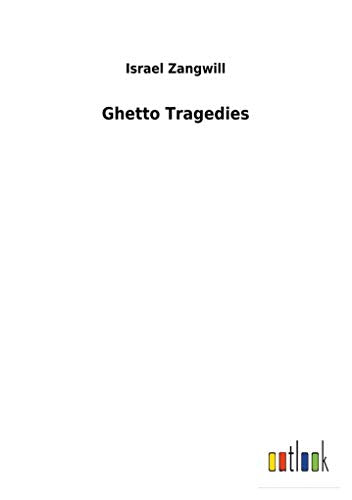
Ghetto Tragedies by Israel Zangwill
Ghetto Tragedies (1899) is a collection of stories by Israel Zangwill. Raised in London by parents from Latvia and Poland, Zangwill understood the plight of the city's Jewish community firsthand. Having risen through poverty to become an educator and author, he dedicated his career to the voiceless, the oppressed, and the needy, advocating for their rights and bearing witness to their suffering in some of the most powerful novels and stories of the Victorian era. People who have been living in a Ghetto for a couple of centuries, are not able to step outside merely because the gates are thrown down, nor to efface the brands on their souls by putting off the yellow badges. The isolation imposed from without will have come to seem the law of their being. As a Jewish immigrant who grew up in poverty in London, Israel Zangwill knows that the condition of life in the ghetto changes not just lives, but mentalities. In the fourth installment of his Ghetto series, Zangwill imagines the lives of everyday Jewish people. Zillah and Jossel, successful boot makers; Daniel Peyser, a father of seven daughters; Isaac Levinsky, the son of a pious Rabbi. These are the lives so lovingly shaped in the author's skillful hands, people whose experiences with love, loss, doubt, and faith are not so different from our own. The tales of Jewish life in Ghetto Tragedies earned Zangwill comparisons to Dickens upon publication and helped to establish him as an author with a gift for intensive character study and a passion for political themes. With a beautifully designed cover and professionally typeset manuscript, this edition of Israel Zangwill's Ghetto Tragedies is a classic of British literature reimagined for modern readers.
Israel Zangwill was a British humorist and writer who lived from January 21, 1864 until August 1, 1926. Zangwill was born in London on January 21, 1864, to Moses Zangwill from Latvia and Ellen Hannah Marks Zangwill from Poland, into a family of Jewish immigrants from Czarist Russia. He devoted his life to fighting for the rights of the disadvantaged. His writing found rich ground in Jewish emancipation, women's suffrage, assimilationism, territorialism, and Zionism. His brother, author Louis Zangwill, was also a writer, and his son, Oliver Zangwill, was a well-known British psychologist.
Zangwill was educated in Plymouth and Bristol throughout his early years. Zangwill was enrolled in the Jews' Free School in Spitalfields, east London, when he was nine years old, a school for Jewish immigrant children. The school provided a demanding course of secular and religious education, as well as clothes, food, and health care for the students; now, one of the school's four houses is named for him. Israel excelled at this institution and even taught part-time before becoming a full-fledged teacher.
He studied for his degree at the University of London, getting a BA with triple honours in 1884 while teaching. Edith Ayrton, a gentile feminist and author, was the daughter of cousins Matilda Chaplin and William Edward Ayrton, and Zangwill married her. Later in life, he made connections with well-known Victorian authors like Jerome K. Jerome. H. and Jerome
| SKU | Nicht verfügbar |
| ISBN 13 | 9783732617180 |
| ISBN 10 | 3732617181 |
| Titel | Ghetto Tragedies |
| Autor | Israel Zangwill |
| Buchzustand | Nicht verfügbar |
| Bindungsart | Paperback |
| Verlag | Salzwasser-Verlag Gmbh |
| Erscheinungsjahr | 2017-12-03 |
| Seitenanzahl | 274 |
| Hinweis auf dem Einband | Die Abbildung des Buches dient nur Illustrationszwecken, die tatsächliche Bindung, das Cover und die Auflage können sich davon unterscheiden. |
| Hinweis | Nicht verfügbar |