
The Harold Letters, 1928-1943


Proud to be B-Corp
The feel-good place to buy books
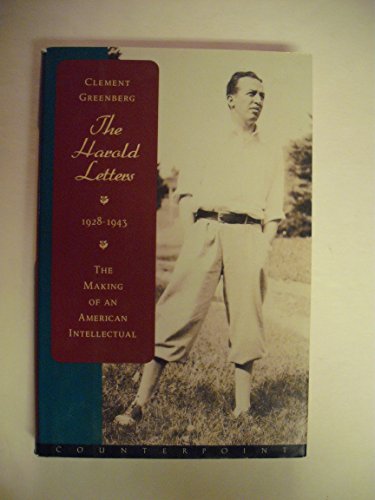
The Harold Letters, 1928-1943 by Clement Greenberg
Candid, breathless, arrogant, ambitious--here, in his own words, is Clement Greenberg, a young man of limitless intellectual appetite on his way to becoming the twentieth century's greatest art critic . Clement Greenberg was, and remains, America's most perceptive, prescient, and influential art critic. More alive than any of his contemporaries to the genius of art in his time, it was Greenberg who, in the 1940s and '50s, charted and celebrated the rise of Abstract Expressionism. The authority of his aesthetic judgment, and the force and clarity of his arguments, went far to establish those artists whose work he championed--Pollock, de Kooning, Hans Hofmann, David Smith.Before all that, however, he was a young man burning to become an intellectual, to make what he called Important Discoveries about art and life. His confidant during these early years was Harold Lazarus, a classmate at Syracuse University and a future professor of English. From 1928, when both were nineteen, until 1943, when they went their separate ways, the two exchanged honest, funny, deeply personal letters. Greenberg's side of the correspondence, here collected by his widow, Janice Van Horne, is the intellect
Greenberg, Clement: - Clement Greenberg (1909 1994), champion of abstract expressionism and modernism of Pollock, Miro, and Matisse has been esteemed by many as the greatest art critic of the second half of the twentieth century, and possibly the greatest art critic of all time. On radio and in print, Greenberg was the voice of the new American painting, and a central figure in the postwar cultural history of the United States.
Greenberg first established his reputation writing for the Partisan Review, which he joined as an editor in 1940. He became art critic forThe Nation in 1942, and was associate editor of Commentary from 1945 until 1957. His seminal essay, Avant-Garde and Kitsch set the terms for the ongoing debate about the relationship of modern high art to popular culture. Though many of his ideas have been challenged, Greenberg has influenced generations of critics, historians, and artists, and he remains influential to this day.
Greenberg first established his reputation writing for the Partisan Review, which he joined as an editor in 1940. He became art critic forThe Nation in 1942, and was associate editor of Commentary from 1945 until 1957. His seminal essay, Avant-Garde and Kitsch set the terms for the ongoing debate about the relationship of modern high art to popular culture. Though many of his ideas have been challenged, Greenberg has influenced generations of critics, historians, and artists, and he remains influential to this day.
| SKU | Nicht verfügbar |
| ISBN 13 | 9781582430683 |
| ISBN 10 | 1582430683 |
| Titel | The Harold Letters, 1928-1943 |
| Autor | Clement Greenberg |
| Buchzustand | Nicht verfügbar |
| Bindungsart | Hardback |
| Verlag | Counterpoint Press |
| Erscheinungsjahr | 2000-06-01 |
| Seitenanzahl | 336 |
| Hinweis auf dem Einband | Die Abbildung des Buches dient nur Illustrationszwecken, die tatsächliche Bindung, das Cover und die Auflage können sich davon unterscheiden. |
| Hinweis | Nicht verfügbar |