


Invisible Ink by John Nagy
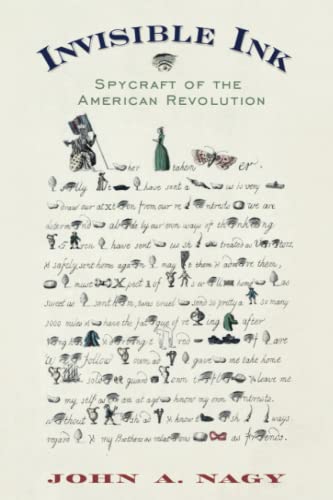
During the American Revolution, espionage was critical to both Continental and British efforts, and those employed in cloak-and-dagger operations risked death. While the most notorious episode of spying during the war, the Benedict Arnold affair, was a failure, most intelligence operations succeeded. Spycraft was no more wholly embraced than by George Washington who relied on a vast spy network and personally designed deceptions and counterintelligence efforts. In Invisible Ink: Spycraft of the American Revolution, John A. Nagy discusses the techniques used by spies during the war. Throughout, he provides examples of the codes and ciphers employed, many of which have not been previously described. In addition, the author analyzes some of the key spy rings. Based on primary research, Invisible Ink is an important contribution to the history of conflict and technology.
Nagy, John A.: - JOHN A. NAGY was a Scholar-in-Residence at Saint Francis University and a consultant on espionage to The Fred W. Smith National Library for the Study of George Washington and the William L. Clement Library. He was the program director for the American Revolution Round Table of Philadelphia and was awarded a Robert H. Smith International Center for Jefferson Studies fellowship to study Thomas Jefferson and cryptology. John was an award-winning author of four books on the American Revolution. He passed away in 2016 after completing George Washington's Secret Spy War.
| SKU | Nicht verfügbar |
| ISBN 13 | 9781594161414 |
| ISBN 10 | 1594161410 |
| Titel | Invisible Ink |
| Autor | John Nagy |
| Buchzustand | Nicht verfügbar |
| Bindungsart | Paperback |
| Verlag | Westholme Publishing, U.S. |
| Erscheinungsjahr | 2011-04-30 |
| Seitenanzahl | 264 |
| Hinweis auf dem Einband | Die Abbildung des Buches dient nur Illustrationszwecken, die tatsächliche Bindung, das Cover und die Auflage können sich davon unterscheiden. |
| Hinweis | Nicht verfügbar |