
Justinian the Great


Proud to be B-Corp
The feel-good place to buy books
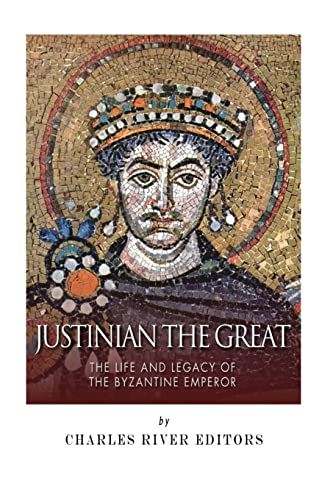
Justinian the Great by Charles River
*Includes pictures*Explains Justinian's foreign policy, domestic policy, the building of the Hagia Sophia, and more
*Includes a bibliography for further reading
The zenith of the Byzantine Empire was reached in the middle of the 6th century during the reign of the Emperor Justinian (527-565). The internal stabilization of the Byzantine state was completed, and Justinian then embarked on a wide range of external re-conquests. Justinian's prime directive was to restore the Roman Empire to its former glory in the west. He sought to strengthen the immutable law that Byzantium, the successor of Rome, maintained not only in the east but also the west, and by doing so, he hoped to revive the unity of the Roman world. In addition to attempting to conquer Italy and restore all the old dominions of the Roman Empire, Justinian also had to quell inner unrest by fighting barbarian usurpers, securing the borders, re-establishing religious orthodoxy, reorganizing the law, and reviving prosperity.
Accounts describe him as a stocky and ugly man, but he was deeply conscious of the prerogatives and duties of his position as a person exalted and close to God, and he was self-controlled in his personal life. From an administrative standpoint, he was an adroit diplomat and organizer who was gifted when it came to choosing collaborators and streamlining the administration of his empire. He was also married to Theodora, a woman of extraordinary beauty, courage, and intellect.
Justinian was profoundly religious, which ensured that he spent considerable time attempting to reestablish orthodoxy and guide the church into the future. Justinian even ensured religious uniformity as this was the same as domestic law. There was no real separation between the legal order and canon law.
At the same time, however, Justinian was a short-sighted emperor who was unable to come to grips with the fact that it was impossible to solve religious conflicts through wavering political compromises. He was also unable to stem the decline in the Byzantine economy and unwilling to form long-term plans for the future that would secure the northern and eastern borders of the empire against the Persians and Slavs. Naturally, since he remained so focused on the present, Justinian also engaged in grandiose propaganda schemes to promote his own glory, such as easy conquests, trading in luxury goods with far-away countries (including China, India, and Abyssinia), a well-planned publicity campaign carried out by his court historian Procopius and his court poet Paul the Silentiary, and a grandiose building campaign in the capital of Constantinople, which included the Hagia Sophia.
Ironically, Justinian's foreign policy is what he is best remembered for, despite the fact it was ultimately unsuccessful. Though he inevitably fell short of at least some of his aims, Justinian did make the Byzantine Empire a more efficient empire in many ways. The Nika revolt in 532 that precipitated the building of Hagia Sophia and the undertaking of Justinian's building campaign was the last major populist insurrection against autocratic rule, and the Marcellinus Conspiracy in 556 was the last of the aristocratic uprisings in the Empire. Justinian succeeded in setting up a nearly bribe-proof civil service, his bureaucrats created a well-disciplined army, and he also succeeded in giving the empire a uniform code of law. That code of law, the corpus juris civilis, or body of civil law, remains the foundation of the legal system in many modern European countries.
Justinian the Great chronicles the life and legacy of the Byzantine Empire's most important leader. Along with pictures depicting important people, places, and events, you will learn about Justinian like never before, in no time at all.
| SKU | Nicht verfügbar |
| ISBN 13 | 9781503190375 |
| ISBN 10 | 1503190374 |
| Titel | Justinian the Great |
| Autor | Charles River |
| Buchzustand | Nicht verfügbar |
| Bindungsart | Paperback |
| Verlag | Createspace Independent Publishing Platform |
| Erscheinungsjahr | 2014-11-11 |
| Seitenanzahl | 44 |
| Hinweis auf dem Einband | Die Abbildung des Buches dient nur Illustrationszwecken, die tatsächliche Bindung, das Cover und die Auflage können sich davon unterscheiden. |
| Hinweis | Nicht verfügbar |