
Kant: Prolegomena to Any Future Metaphysics


Kant: Prolegomena to Any Future Metaphysics
Regular price
Checking stock...
Regular price
Checking stock...
Zusammenfassung
This new translation of Kant's Prolegomena, which is the best introduction to his philosophy, also includes selections from the Critique of Pure Reason, which fill out and explicate some of his central arguments. The volume is completed by a historical and philosophical introduction, explanatory notes, a chronology and a guide to further reading.
The feel-good place to buy books
- Free delivery in the UK
- Supporting authors with AuthorSHARE
- 100% recyclable packaging
- B Corp - kinder to people and planet
- Buy-back with World of Books - Sell Your Books
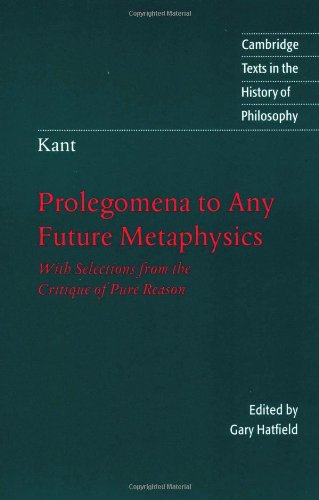
Kant: Prolegomena to Any Future Metaphysics by Immanuel Kant
Kant is the central figure of modern philosophy. He sought to rebuild philosophy from the ground up, and he succeeded in permanently changing its problems and methods. This new translation of the Prolegomena, which is the best introduction to his philosophy, presents his thought clearly by paying careful attention to his original language. Also included are selections from the Critique of Pure Reason, which fill out and explicate some of Kant's central arguments, and in which Kant himself explains his special terminology. The volume is completed by a historical and philosophical introduction, explanatory notes, a chronology and a guide to further reading.
'Hatfield's translation is new … [He] handles very carefully central concepts of the Kantian text that are difficult to translate … It can be highly recommended especially for university courses' Konstantin Pollok, University of Marburg, Kant-Studien
Kant, Immanuel: - Immanuel Kant ( 22 April 1724 - 12 February 1804) was an influential German philosopher[23] in the Age of Enlightenment. In his doctrine of transcendental idealism, he argued that space, time, and causation are mere sensibilities; things-in-themselves exist, but their nature is unknowable.[24][25] In his view, the mind shapes and structures experience, with all human experience sharing certain structural features. In one of his major works, the Critique of Pure Reason (1781; second edition 1787), [26] he drew a parallel to the Copernican revolution in his proposition that worldly objects can be intuited a priori ('beforehand'), and that intuition is therefore independent from objective reality.[b] Kant believed that reason is also the source of morality, and that aesthetics arise from a faculty of disinterested judgment. Kant's views continue to have a major influence on contemporary philosophy, especially the fields of epistemology, ethics, political theory, and post-modern aesthetics. He attempted to explain the relationship between reason and human experience and to move beyond the failures of traditional philosophy and metaphysics. He wanted to put an end to what he saw as an era of futile and speculative theories of human experience, while resisting the skepticism of thinkers such as David Hume. He regarded himself as showing the way past the impasse between rationalists and empiricists, [28] and is widely held to have synthesized both traditions in his thought.[29] Kant was an exponent of the idea that perpetual peace could be secured through universal democracy and international cooperation. He believed that this would be the eventual outcome of universal history, although it is not rationally planned.[30] The nature of Kant's religious ideas continues to be the subject of philosophical dispute, with viewpoints ranging from the impression that he was an initial advocate of atheism who at some point developed an ontological argument for God, to more critical treatments epitomized by Schopenhauer, who criticized the imperative form of Kantian ethics as theological morals and the Mosaic Decalogue in disguise, [31] and Nietzsche, who claimed that Kant had theologian blood[32] and was merely a sophisticated apologist for traditional Christian faith
| SKU | Nicht verfügbar |
| ISBN 13 | 9780521575423 |
| ISBN 10 | 0521575427 |
| Titel | Kant: Prolegomena to Any Future Metaphysics |
| Autor | Immanuel Kant |
| Serie | Cambridge Texts In The History Of Philosophy |
| Buchzustand | Nicht verfügbar |
| Bindungsart | Paperback |
| Verlag | Cambridge University Press |
| Erscheinungsjahr | 1997-05-01 |
| Seitenanzahl | 233 |
| Hinweis auf dem Einband | Die Abbildung des Buches dient nur Illustrationszwecken, die tatsächliche Bindung, das Cover und die Auflage können sich davon unterscheiden. |
| Hinweis | Nicht verfügbar |