
LiDAR Principles, Processing and Applications in Forest Ecology


Proud to be B-Corp
The feel-good place to buy books
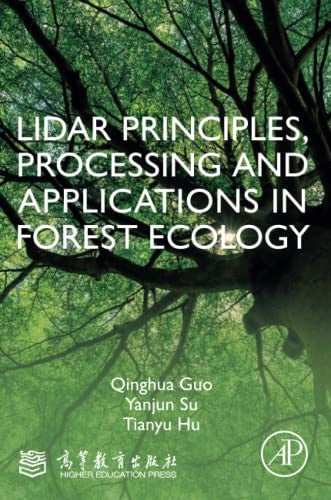
LiDAR Principles, Processing and Applications in Forest Ecology by Qinghua Guo
LiDAR Principles, Processing and Applications in Forest Ecology introduces the principles of LiDAR technology and explains how to collect and process LiDAR data from different platforms based on real-world experience. The book provides state-of the-art algorithms on how to extract forest parameters from LiDAR and explains how to use them in forest ecology. It gives an interdisciplinary view, from the perspective of remote sensing and forest ecology. Because LiDAR is still rapidly developing, researchers must use programming languages to understand and process LiDAR data instead of established software. In response, this book provides Python code examples and sample data. Sections give a brief history and introduce the principles of LiDAR, as well as three commonly seen LiDAR platforms. The book lays out step-by-step coverage of LiDAR data processing and forest structure parameter extraction, complete with Python examples. Given the increasing usefulness of LiDAR in forest ecology, this volume represents an important resource for researchers, students and forest managers to better understand LiDAR technology and its use in forest ecology across the world. The title contains over 15 years of research, as well as contributions from scientists across the world.
Dr. Qinghua Guo is currently a professor in Peking University, and serves as the director of the Institute of Remote Sensing & Geographical Information System, Peking University. He received the B.S. and M.S. degrees in Peking University, and the Ph.D degrees in University of California Berkeley. His recent research interests lie in developing near-surface (e.g., backpack, UAV and mobile) Lidar hardware and data processing software systems and combining them with airborne and spaceborne remote sensing data to map vegetation attributes (e.g., tree height, LAI, AGB, vegetation type) from individual plant scale to national and global scales. So far, he has published over 160 peer-reviewed papers. Dr. Yanjun Su is a professor in the Institute of Botany, Chinese Academy of Sciences. He received a B.E. degree from the China University of Geosciences (Beijing) in 2009, a M.S. degree from the Institute of Geographic Sciences and Natural Resources Research, Chinese Academy of Sciences, and a Ph.D. degree from the University of California Merced in 2017. His research interests lie in using lidar to quantify vegetation structures and combining lidar-derived vegetation structures with other remote sensing techniques to understand how human activities and global climate change influence terrestrial ecosystems. So far, he has published over 70 peer-reviewed papers, and has received several academic awards, such as the “William A. Fisher Memorial Scholarship from the American Society of Photogrammetry and Remote Sensing. Dr. Tianyu Hu is an associate professor in the Institute of Botany, Chinese Academy of Sciences. He received a B.S. degree in ecology from China Agriculture University, Beijing, China, in 2008, and a Ph.D. degree from the Institute of Botany, Chinese Academy of Sciences, Beijing, in 2014. His research focuses on using light detection and ranging (LiDAR) technology and dynamic global vegetation model to understand forest ecosystem, especially in forest structure, function, and biodiversity. Currently, He has published more than 30 peer-reviewed journal papers in the ecology and remote sensing, including Global Biogeochemical Cycles, Forest Ecology and Management, Remote Sensing of Environment, International Journal of Applied Earth Observations and Geoinformation and Remote Sensing etc
| SKU | Nicht verfügbar |
| ISBN 13 | 9780128238943 |
| ISBN 10 | 0128238941 |
| Titel | LiDAR Principles, Processing and Applications in Forest Ecology |
| Autor | Qinghua Guo |
| Buchzustand | Nicht verfügbar |
| Bindungsart | Paperback |
| Verlag | Elsevier Science Publishing Co Inc |
| Erscheinungsjahr | 2023-03-10 |
| Seitenanzahl | 510 |
| Hinweis auf dem Einband | Die Abbildung des Buches dient nur Illustrationszwecken, die tatsächliche Bindung, das Cover und die Auflage können sich davon unterscheiden. |
| Hinweis | Nicht verfügbar |