
Living Forms of the Imagination


Zusammenfassung
The feel-good place to buy books
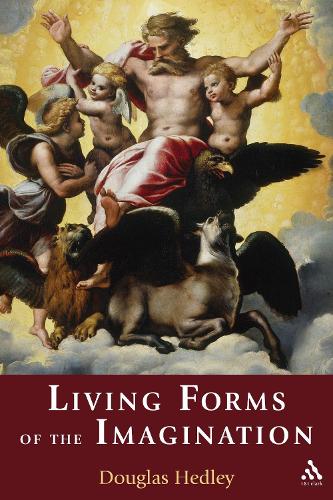
Living Forms of the Imagination by Douglas Hedley
Religious belief characteristically requires imaginative engagement. If this is not to be confused with fantasy or wish fulfilment, we need some account of how the imagination can be used through images of salvation: symbols and sacred narratives. Metaphysical reductionism inspired by success of the physical science, especially by employment of recent molecular biology, creates an unprecedented challenge for reflective religious belief: ontology is confined to scientific description. Christian theology in particular has a long tradition of 'faith seeking understanding'. This project is rendered implausible, if not totally incoherent, if the reductionist project prevails.There have been many forms of anti-reductionism in philosophical theology and in Anglophone discussion of religion. This book argues that the concept of imagination must play a core role in any successful anti-reductionist account. The role of imagination in psychology, ethics and aesthetics provides a good analogy for thinking about the imagination in religious belief. In dealing with the inner lives of other human beings, moral values or aesthetic qualities we need to employ the imagination: to suppose; form hypotheses; empathise or imaginatively engage with alien people or worlds in order to understand. The imaginative skills required remain very different from any quantifiable account of items and events in time and space, and yet remain necessary for the acquisition of genuine knowledge. Just as we use the imagination to relate to other minds, appreciate beauty and understand goodness, we need imagination to engage with God's action in the world.
This is an impressively learned bookImagination is a central component of humanity's encounter with the world. Imagination can lea to conversion of heart and empowerment for action. While the author's retrieval of Platonism and Romanticism may not answer fundamental contemporary issues in belief, it is very suggestive of new avenues of how to deal with the crisis of belief and unbelief. * Catholic Library World *
[A] rich and eloquent study. * Religious Studies *
Impressively, Hedley succeeds in bringing together the various strands of the history of philosophy, art, and literature from antiquity to the present time. (Bloomsbury Translation) * Theologische Rundschau *
Living Forms of the Imagination is a remarkably learned book, wide-ranging in the philosophical, literary and theological discussions it broaches. * The Way *
Douglas Hedley has aroused substantive and substantial expectations in his earlier books and articles. I know my own graduate students in religion and the arts to have drunk deeply from his wells, in particular his book on Coleridge. With this, his first volume in a trilogy of books on the religious imagination, he not only exacerbates those expectations but, more importantly, instaurates plenary delivery on them. Thus with this book he launches the first craft of this trilogical convoy, and what a flotilla it promises to be (perhaps, once again, Britannia rules the waves?)! One's greatest hope for a book as important as this one is that it will find, or create, competent readers...My earnest advice to the reader, in closing, is to discount this and other reviews and read Douglas Hedley's magisterial book for yourself. You will be instructed, your thought will be challenged (as has mine), and you will 'afterthink' him for years to come. * Modern Theology *
Overall Hedley presents an elegantly composed study which reads well and traces its argument to the conclusion that the imagination is a place to encounter both deity and humanity. The indices allow quick/easy access to the many well-informed contexts which feature brilliant individual observations. However, in my opinion, the ultimate importance of Hedley's publication can be found elsewhere. Namely, it ties in with the current discussion on Bildtheorie - the theory of images [or pictures]. There, one distinguishes between an analytical, a phenomenological and an anthropological approach. * Theologische Literaturzeitung *
Nuanced, lucid and scholarly work...this book is a welcome reminder of the full panoply of human resources for revealing God. -- Donald J. Dietrich, Boston College, USA
Living Forms of the Imagination is a compelling, erudite articulation and defense of the indispensable cognitive value of the imagination in the philosophy of nature and God. Elegantly written, this book draws on Platonic and Romantic traditions to create a brilliant challenge to contemporary, reductive naturalists and those who, following Ryle, advance a deflationary account of the imagination. This book is essential reading for those interested in the imagination, epistemology, naturalism, and the philosophy of religion. -- Charles Taliaferro, Professor of Philosophy, St. Olaf College, MN, USA
Mentioned in new books of the week in Times Higher Education Supplement, 24 January 2008
[A] rich and eloquent study. * Religious Studies *
Impressively, Hedley succeeds in bringing together the various strands of the history of philosophy, art, and literature from antiquity to the present time. (Bloomsbury Translation) * Theologische Rundschau *
Living Forms of the Imagination is a remarkably learned book, wide-ranging in the philosophical, literary and theological discussions it broaches. * The Way *
Douglas Hedley has aroused substantive and substantial expectations in his earlier books and articles. I know my own graduate students in religion and the arts to have drunk deeply from his wells, in particular his book on Coleridge. With this, his first volume in a trilogy of books on the religious imagination, he not only exacerbates those expectations but, more importantly, instaurates plenary delivery on them. Thus with this book he launches the first craft of this trilogical convoy, and what a flotilla it promises to be (perhaps, once again, Britannia rules the waves?)! One's greatest hope for a book as important as this one is that it will find, or create, competent readers...My earnest advice to the reader, in closing, is to discount this and other reviews and read Douglas Hedley's magisterial book for yourself. You will be instructed, your thought will be challenged (as has mine), and you will 'afterthink' him for years to come. * Modern Theology *
Overall Hedley presents an elegantly composed study which reads well and traces its argument to the conclusion that the imagination is a place to encounter both deity and humanity. The indices allow quick/easy access to the many well-informed contexts which feature brilliant individual observations. However, in my opinion, the ultimate importance of Hedley's publication can be found elsewhere. Namely, it ties in with the current discussion on Bildtheorie - the theory of images [or pictures]. There, one distinguishes between an analytical, a phenomenological and an anthropological approach. * Theologische Literaturzeitung *
Nuanced, lucid and scholarly work...this book is a welcome reminder of the full panoply of human resources for revealing God. -- Donald J. Dietrich, Boston College, USA
Living Forms of the Imagination is a compelling, erudite articulation and defense of the indispensable cognitive value of the imagination in the philosophy of nature and God. Elegantly written, this book draws on Platonic and Romantic traditions to create a brilliant challenge to contemporary, reductive naturalists and those who, following Ryle, advance a deflationary account of the imagination. This book is essential reading for those interested in the imagination, epistemology, naturalism, and the philosophy of religion. -- Charles Taliaferro, Professor of Philosophy, St. Olaf College, MN, USA
Mentioned in new books of the week in Times Higher Education Supplement, 24 January 2008
Douglas Hedley is senior Lecturer in the Philosophy of Religion in the Divinity faculty at Cambridge and Fellow of Clare College. A past President of the European Society for the Philosophy of Religion, He has been visiting Professor at the Sorbonne and holder of the Alan Richardson lectureship at Durham University. He has delivered the Teape Lectures in India in 2007. His former publications include Coleridge, Philosophy and Religion (CUP).
| SKU | Nicht verfügbar |
| ISBN 13 | 9780567032959 |
| ISBN 10 | 0567032957 |
| Titel | Living Forms of the Imagination |
| Autor | Douglas Hedley |
| Buchzustand | Nicht verfügbar |
| Bindungsart | Paperback |
| Verlag | Bloomsbury Publishing PLC |
| Erscheinungsjahr | 2008-02-28 |
| Seitenanzahl | 320 |
| Hinweis auf dem Einband | Die Abbildung des Buches dient nur Illustrationszwecken, die tatsächliche Bindung, das Cover und die Auflage können sich davon unterscheiden. |
| Hinweis | Nicht verfügbar |