


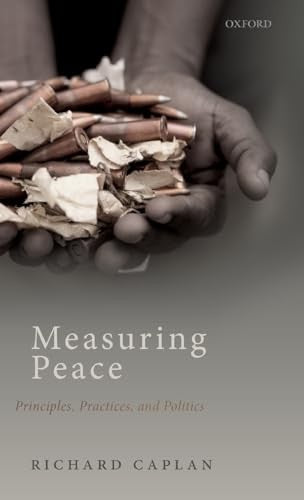
Measuring Peace by Richard Caplan
How can we know if the peace that has been established following a civil war is a stable peace? More than half of all countries that experienced civil war since World War II have suffered a relapse into violent conflict, in some cases more than once. Meanwhile the international community expends billions of dollars and deploys tens of thousands of personnel each year in support of efforts to build peace in countries emerging from violent conflict. This book argues that efforts to build peace are hampered by the lack of effective means of assessing progress towards the achievement of a consolidated peace. Rarely, if ever, do peacebuilding organizations and governments seek to ascertain the quality of the peace that they are helping to build and the contribution that their engagement is making (or not) to the consolidation of peace. More rigorous assessments of the robustness of peace are needed. These assessments require clarity about the characteristics of, and the requirements for, a stable peace. This in turn requires knowledge of the local culture, local history, and the specific conflict dynamics at work in a given conflict situation. Better assessment can inform peacebuilding actors in the reconfiguration and reprioritization of their operations in cases where conditions on the ground have deteriorated or improved. To build a stable peace, it is argued here, it is important to take the measure of peace.
Measuring Peace adds significantly and provocatively to a fractious and controversial but nevertheless enduring conversation about what peace is – conceptually, operationally and practically – as well as considering how we should study this crucial phenomenon* Christian Davenport, University of Michigan, Perspectives on Politics *
This book...provides a much needed framework for policy deliberations that might eventually contribute toward preventing the recurrence of conflicts. * Abhishek Choudhary, University of Delhi, Peace & Change *
For academics, this book is a welcome addition to scholarship that has long sought to understand the impact that peacebuilding may or may not have on creating a stable peace. For practitioners, it will help them become more rigorous in finding definitions even when they appear elusive and provides valuable insight into which strategic assessment and measurement tools are working for leaders in the peacebuilding industry. * Sara Winger, The University of Calgary, Canada, International Affairs *
The book is well documented and includes an extensive bibliography...recommended. * R.P. Peters, Harvard University, CHOICE *
In Measuring Peace, Richard Caplan sets out to answer an important question for those engaged in some or other way in contributing to bringing about peace, namely 'how can we know if the peace that has been established following a civil war is a stable peace?'. Caplan emphasizes at the outset that his book is about measuring peace consolidation, not about evaluating peacebuilding success. He argues that the two topics are closely related but distinct. * Cedric De Coning, Norwegian Institute of International Affairs, Ethnopolitics *
In Measuring Peace: Principles, Practices and Politics, Richard Caplan asks compellingly: 'how can we know if the peace that has been established following civil war is a stable peace?'...By seeking to examine what counts as stable peace in a more strategic and robust way, Caplan also opens a window of opportunity. * 'Funmi Olonisakin, African Leadership Centre, School of Global Affairs, King's College London, Ethnopolitics *
...[an] excellent study on measuring success in peacebuilding... * Mats Berdal, The International Institute for Strategic Studies *
Measuring Peace: Principles, Practices and Politics, provides a useful discussion, demonstration and overview of international efforts to measure peace consolidation and would be of particular interest to scholars of international peacebuilding and development efforts, as well as practitioners striving to learn more about the international community's efforts at measuring peace. * Pamina Firchow, Brandeis University, International Peacekeeping *
Measuring Peace is a spectacular scholarly achievement and clearly shows where academia can have a policy impact. It can serve as a useful tool in the hands of peacebuilders facing the daunting task of measuring the quality of peace. * Jessie Barton Hroneová, Oxford University, OXPOL: The Oxford University Politics Blog *
Caplan is a leading scholar in the effort to encourage the international community to take the measurement of peace more seriously. * Andrew Rathmell, The RUSI Journal *
This book...provides a much needed framework for policy deliberations that might eventually contribute toward preventing the recurrence of conflicts. * Abhishek Choudhary, University of Delhi, Peace & Change *
For academics, this book is a welcome addition to scholarship that has long sought to understand the impact that peacebuilding may or may not have on creating a stable peace. For practitioners, it will help them become more rigorous in finding definitions even when they appear elusive and provides valuable insight into which strategic assessment and measurement tools are working for leaders in the peacebuilding industry. * Sara Winger, The University of Calgary, Canada, International Affairs *
The book is well documented and includes an extensive bibliography...recommended. * R.P. Peters, Harvard University, CHOICE *
In Measuring Peace, Richard Caplan sets out to answer an important question for those engaged in some or other way in contributing to bringing about peace, namely 'how can we know if the peace that has been established following a civil war is a stable peace?'. Caplan emphasizes at the outset that his book is about measuring peace consolidation, not about evaluating peacebuilding success. He argues that the two topics are closely related but distinct. * Cedric De Coning, Norwegian Institute of International Affairs, Ethnopolitics *
In Measuring Peace: Principles, Practices and Politics, Richard Caplan asks compellingly: 'how can we know if the peace that has been established following civil war is a stable peace?'...By seeking to examine what counts as stable peace in a more strategic and robust way, Caplan also opens a window of opportunity. * 'Funmi Olonisakin, African Leadership Centre, School of Global Affairs, King's College London, Ethnopolitics *
...[an] excellent study on measuring success in peacebuilding... * Mats Berdal, The International Institute for Strategic Studies *
Measuring Peace: Principles, Practices and Politics, provides a useful discussion, demonstration and overview of international efforts to measure peace consolidation and would be of particular interest to scholars of international peacebuilding and development efforts, as well as practitioners striving to learn more about the international community's efforts at measuring peace. * Pamina Firchow, Brandeis University, International Peacekeeping *
Measuring Peace is a spectacular scholarly achievement and clearly shows where academia can have a policy impact. It can serve as a useful tool in the hands of peacebuilders facing the daunting task of measuring the quality of peace. * Jessie Barton Hroneová, Oxford University, OXPOL: The Oxford University Politics Blog *
Caplan is a leading scholar in the effort to encourage the international community to take the measurement of peace more seriously. * Andrew Rathmell, The RUSI Journal *
Richard Caplan is Professor of International Relations at the University of Oxford. He has written extensively on international organizations and conflict management, specifically on post-conflict peace- and state-building. He is the author of International Governance of War-Torn Territories (Oxford University Press, 2005) and Europe and the Recognition of New States in Yugoslavia (Cambridge University Press, 2005), and the editor of Exit Strategies and State Building (OUP, 2012) and Europe's New Nationalism: States and Minorities in Conflict (OUP, 1996). He has served as a Specialist-Advisor to the Select Foreign Affairs Committee of the UK House of Commons, a consultant to the UN Peacebuilding Support Office, and a member of the World Economic Forum's Global Agenda Council on Fragile States.
| SKU | Nicht verfügbar |
| ISBN 13 | 9780198810360 |
| ISBN 10 | 0198810369 |
| Titel | Measuring Peace |
| Autor | Richard Caplan |
| Buchzustand | Nicht verfügbar |
| Bindungsart | Hardback |
| Verlag | Oxford University Press |
| Erscheinungsjahr | 2019-04-25 |
| Seitenanzahl | 170 |
| Preise | Winner of Shortlisted for the Conflict Research Society Book Prize. |
| Hinweis auf dem Einband | Die Abbildung des Buches dient nur Illustrationszwecken, die tatsächliche Bindung, das Cover und die Auflage können sich davon unterscheiden. |
| Hinweis | Nicht verfügbar |