
Men and the Emergence of Polite Society, Britain 1660-1800


Men and the Emergence of Polite Society, Britain 1660-1800
Regular price
Checking stock...
Regular price
Checking stock...
Zusammenfassung
A vivid account of the changing status of men and masculinity as Britain moved into the modern period reveals the significance of social over sexual conduct for eighteenth century definitions of masculinity, using personal stories and diverse public statements drawn from conduct books, magazines, sermons and novels.
The feel-good place to buy books
- Free delivery in the UK
- Supporting authors with AuthorSHARE
- 100% recyclable packaging
- B Corp - kinder to people and planet
- Buy-back with World of Books - Sell Your Books
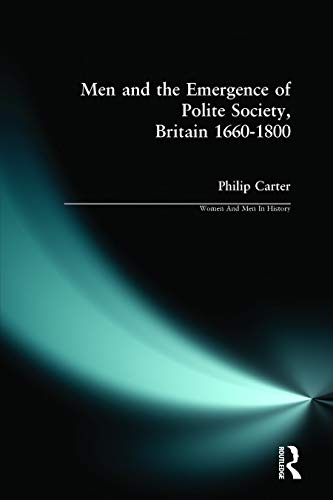
Men and the Emergence of Polite Society, Britain 1660-1800 by Philip Carter
WOMEN AND MEN IN HISTORY SERIES General Editors: Patricia Skinner, Pamela Sharpe & Penny Summerfield This book presents an account of masculinity in eighteenth century Britain. In particular it is concerned with the impact of an emergent polite society on notions of manliness and the gentleman. From the 1660s a new type of social behaviour, politeness, was promoted by diverse writers. Based on continental ideas of refinement, it stressed the merits of genuine and generous sociability as befitted a progressive and tolerant nation. Early eighteenth century writers encouraged men to acquire the characteristics of politeness by becoming urbane town gentlemen. Later commentators promoted an alternative culture of sensibility typified by the man of feeling. Central to both was the need to spend more time with women, now seen as key agents of refinement. The relationship demanded a reworking of what it meant to be manly. Being manly and polite was a difficult balancing act. Refined manliness presented new problems for eighteenth century men. What was the relationship between politeness and duplicity? Were feminine actions such as tears and physical delicacy acceptable or not? Critics believed polite society led to effeminacy, not manliness, and condemned this failure of male identity with reference to the fop. This book reveals the significance of social over sexual conduct for eighteenth century definitions of masculinity. It shows how features traditionally associated with nineteenth century models were well established in the earlier figure of the polite town-dweller or sentimental man of feeling. Using personal stories and diverse public statements drawn from conduct books, magazines, sermons and novels, this is a vivid account of the changing status of men and masculinity as Britain moved into the modern period. Philip Carter is Research Editor on the New Dictionary of National Biography and Junior Research Fellow at Wolfson College, Oxford.
"concise and well-written" Times Literary Supplement"an exemplary approach to the workings of gender in eighteenth-century society" The British Journal of Eighteenth Century Studies "Carter who breaks new ground, with a show of formidably constructed analysis and reasoned argument" History Today, May 2002
Philip Carter is Research Editor on the New Dictionary of National Biography and Junior Research Fellow at Wolfson College, Oxford.
| SKU | Nicht verfügbar |
| ISBN 13 | 9780582319875 |
| ISBN 10 | 0582319870 |
| Titel | Men and the Emergence of Polite Society, Britain 1660-1800 |
| Autor | Philip Carter |
| Serie | Women And Men In History |
| Buchzustand | Nicht verfügbar |
| Bindungsart | Paperback |
| Verlag | Taylor & Francis Ltd |
| Erscheinungsjahr | 2000-10-19 |
| Seitenanzahl | 240 |
| Hinweis auf dem Einband | Die Abbildung des Buches dient nur Illustrationszwecken, die tatsächliche Bindung, das Cover und die Auflage können sich davon unterscheiden. |
| Hinweis | Nicht verfügbar |