
Microsystem Design


Zusammenfassung
The feel-good place to buy books
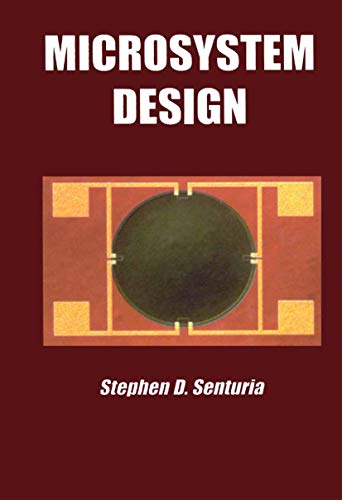
Microsystem Design by Stephen D Senturia
It is a real pleasure to write the Foreword for this book, both because I have known and respected its author for many years and because I expect this book’s publication will mark an important milestone in the continuing worldwide development of microsystems. By bringing together all aspects of microsystem design, it can be expected to facilitate the training of not only a new generation of engineers, but perhaps a whole new type of engineer – one capable of addressing the complex range of problems involved in reducing entire systems to the micro- and nano-domains. This book breaks down disciplinary barriers to set the stage for systems we do not even dream of today. Microsystems have a long history, dating back to the earliest days of mic- electronics. While integrated circuits developed in the early 1960s, a number of laboratories worked to use the same technology base to form integrated sensors. The idea was to reduce cost and perhaps put the sensors and circuits together on the same chip. By the late-60s, integrated MOS-photodiode arrays had been developed for visible imaging, and silicon etching was being used to create thin diaphragms that could convert pressure into an electrical signal. By 1970, selective anisotropic etching was being used for diaphragm formation, retaining a thick silicon rim to absorb package-induced stresses. Impurity- and electrochemically-based etch-stops soon emerged, and "bulk micromachining" came into its own.Stephen D. Senturia joined the Department of Electrical Engineering and Computer Science at M.I.T. immediately after completing his education (MIT, Ph.D. in Physics, 1966), initially as Research Scientist, then as Assistant Professor in 1967, with subsequent promotions up the ranks. From 1992 to 2002, he held the Barton L. Weller Chair in Electrical Engineering. He has been involved in microsensor and MEMS research since the early 1970's. For a number of years, his research focused on developing material-property measurement methods and CAD tools for MEMS. The work on MEMCAD led to the spin-out from his group of the two companies that lead this commercial field: IntelliSense and Coventor.He serves as Senior Editor of the ASME/IEEE Journal of Microelectromechanical Systems. After officially retiring from MIT in June, 2002, Dr. Senturia now has part-time duties at MIT and serves as Chairman and Chief Technology Officer of Polychromix, Inc., Woburn, MA, a company he founded to adapt the Polychromator technology for commercial use. Honor and professional societies include the IEEE (Fellow), Phi Beta Kappa, and Sigma Xi.
Terry P. Orlando is a Professor at the Research Laboratory of Electronics at M.I.T. His research focuses on superconducting circuits for quantum computation and nonlinear dynamics.
| SKU | Nicht verfügbar |
| ISBN 13 | 9780792372462 |
| ISBN 10 | 0792372468 |
| Titel | Microsystem Design |
| Autor | Stephen D Senturia |
| Buchzustand | Nicht verfügbar |
| Bindungsart | Hardback |
| Verlag | Springer |
| Erscheinungsjahr | 2000-11-30 |
| Seitenanzahl | 689 |
| Hinweis auf dem Einband | Die Abbildung des Buches dient nur Illustrationszwecken, die tatsächliche Bindung, das Cover und die Auflage können sich davon unterscheiden. |
| Hinweis | Nicht verfügbar |