


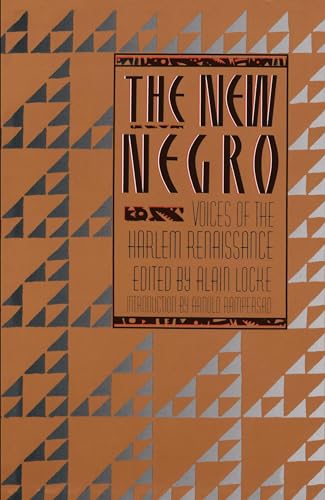
The New Negro by Locke
From the man known as the father of the Harlem Renaissance comes a powerful, provocative, and affecting anthology of writers who shaped the Harlem Renaissance movement and who help us to consider the evolution of the African American in society. With stunning works by seminal black voices such as Zora Neale Hurston, Countee Cullen, and W.E.B. DuBois, Locke has constructed a vivid look at the new negro, the changing African American finding his place in the ever shifting sociocultural landscape that was 1920s America. With poetry, prose, and nonfiction essays, this collection is widely praised for its literary strength as well as its historical coverage of a monumental and fascinating time in the history of America.Alain Locke (1885-1954) was an African American philosopher, scholar, educator, and patron of the arts. Born in Philadelphia, Locke was raised the only child of Pliny Ishmael and Mary Locke. His father was the first black employee of the United States Postal Service, and his mother was a teacher. He excelled at Central High School before enrolling at Harvard University in 1907, where he was made a member of the Phi Beta Kappa Society, was awarded the Bowdoin prize, and became the first African American recipient of the prestigious Rhodes Scholarship. He attended Hertford College at Oxford, overcoming several rejections from other schools attached to the university to study literature, philosophy, Greek, and Latin. After four years as an assistant professor at Howard University, Locke returned to Harvard to complete his doctoral dissertation on the nature of social values. Back at Howard, he worked as the chair of the philosophy department and advocated for equal pay for black and white faculty, which ultimately led to his dismissal in 1925. That same year, he expanded an issue of Survey Graphic, a sociopolitical magazine, into The New Negro, a groundbreaking anthology of writing from Countee Cullen, Langston Hughes, Zora Neale Hurston, Jean Toomer, and himself. The New Negro would become a foundational text of the Harlem Renaissance, establishing Locke's reputation as a leading voice on African American arts and culture and a figurehead of the movement. He regained his position at Howard University in 1928, teaching generations of philosophy students until his retirement in 1953. Due to his race and homosexuality, Locke has been long overlooked by scholars and the public at large.
| SKU | Nicht verfügbar |
| ISBN 13 | 9780684838311 |
| ISBN 10 | 0684838311 |
| Titel | The New Negro |
| Autor | Locke |
| Buchzustand | Nicht verfügbar |
| Bindungsart | Paperback |
| Verlag | Simon & Schuster |
| Erscheinungsjahr | 1999-03-01 |
| Seitenanzahl | 467 |
| Hinweis auf dem Einband | Die Abbildung des Buches dient nur Illustrationszwecken, die tatsächliche Bindung, das Cover und die Auflage können sich davon unterscheiden. |
| Hinweis | Nicht verfügbar |