
The Nicomachean Ethics


The Nicomachean Ethics
Regular price
Checking stock...
Regular price
Checking stock...
Zusammenfassung
This work contains Artistotle's views on what makes a good human life. It has served as an influence on the history of ideas and offers insights into the human condition.
The feel-good place to buy books
- Free delivery in the UK
- Supporting authors with AuthorSHARE
- 100% recyclable packaging
- B Corp - kinder to people and planet
- Buy-back with World of Books - Sell Your Books
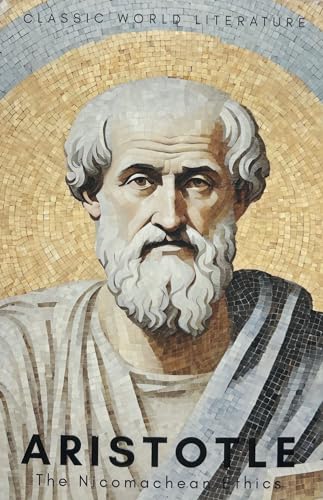
The Nicomachean Ethics by Aristotle
Aristotle (384-322BC) is the philosopher who has most influence on the development of western culture, writing on a wide variety of subjects including the natural sciences as well as the more strictly philosophical topics of logic, metaphysics and ethics. To the poet Dante, he was simply 'the master of those who know'. The Ethics contains his views on what makes a good human life. While the work continues to stimulate and challenge modern philosophers, the general course of the argument is easily accessible to the non-specialist. Both as a key influence in the history of ideas and as a work containing unique insights into the human condition, this is a book that simply demands to be read.
ARISTOTLE was born in the northern Greek town of Stagira in 384 B.C.E., where his father was the personal physician to the great-grandfather of Alexander the Great. At the age of eighteen Aristotle entered Plato's Academy and soon became recognized as its most important student. He remained under Plato's tutelage for nearly twenty years. After his teacher's death in 347 B.C.E., Aristotle cultivated associations with other Academy students throughout Greece and Asia Minor. Then in 342 B.C.E., Aristotle was asked by King Philip II of Macedonia to become the tutor for his young son Alexander, who was later to become the conqueror of much of the known world at that time. The young prince remained under Aristotle's supervision until 336 B.C.E., when he acceded to the throne after his father's death. Two years later Aristotle returned to Athens and founded his own school, which he called the Lyceum. This intellectual center flourished during the years when Alexander the Great ruled Greece as part of his large empire. But upon Alexander's death in 323 B.C.E., Aristotle was charged with impiety by Athenians who resented his associations with the Macedonian conqueror. Rather than risk the same fate as Plato's mentor, Socrates, Aristotle fled to the city of Chalcis, where he died in 322 B.C.E. Aristotle's interests, like those of Plato, were diverse and his writing cast its shadow on many fields, including logic, metaphysics, epistemology, ethics, politics, and the sciences. Among his most well-known works are: The Categories, The Prior and Posterior Analytics, The Physics, The Meta-physics, De Anima, The Nicomachean Ethics, and The Politics.
| SKU | Nicht verfügbar |
| ISBN 13 | 9781853264610 |
| ISBN 10 | 185326461X |
| Titel | The Nicomachean Ethics |
| Autor | Aristotle |
| Serie | Classics Of World Literature |
| Buchzustand | Nicht verfügbar |
| Bindungsart | Paperback |
| Verlag | Wordsworth Editions Ltd |
| Erscheinungsjahr | 1996-09-05 |
| Seitenanzahl | 320 |
| Hinweis auf dem Einband | Die Abbildung des Buches dient nur Illustrationszwecken, die tatsächliche Bindung, das Cover und die Auflage können sich davon unterscheiden. |
| Hinweis | Nicht verfügbar |