
An Occupational Therapist's Guide to Home Modification Practice


Zusammenfassung
The feel-good place to buy books
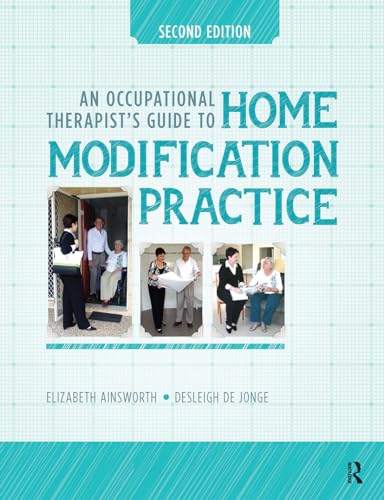
An Occupational Therapist's Guide to Home Modification Practice by Elizabeth Ainsworth
With the integration of people with disabilities into society, there has been increasing interest in modifying homes to enable them to live independently in the community. The aging population has also raised concerns about how well homes can support older peoples' health and safety as they age. Occupational therapists require skills and knowledge to assess the modification needs of these clients including consideration of their current and future requirements and the nature and use of the home environment. An Occupational Therapist's Guide to Home Modification Practice by Elizabeth Ainsworth and Desleigh De Jonge, uses a transactional approach to examine the person in their home environment. The text assists occupational therapists in addressing the needs of consumers, including consideration of their current and future requirements, the nature and use of the home environment, understanding the technical aspects of the built environment, design approaches, and the application of a range of products and finishes to determine appropriate modification solutions. An Occupational Therapist's Guide to Home Modification Practice provides occupational therapists with valuable information and expertise for identifying home modification requirements. The text discusses how to consider the personal, cultural, social, temporal, and physical aspects of the home in decision making and provides occupational therapists with a systematic process for identifying and evaluating home-based interventions.Elizabeth Ainsworth, MOccThy, Grad Cert Health Sci graduated in 1989 with a bachelor of occupational therapy (honors) degree and completed a master’s in occupational therapy (contemporary clinical practice at the University of Queensland) and a graduate certificate in health science (environmental modifications at the University of Sydney) in 2000. She is a private practice occupational therapist, accredited and qualified access consultant, and PhD candidate at The University of Queensland.
Elizabeth has had over 20 years’ experience aiding older people and people with disabilities who require home modifications or alternative housing. She has a history of working in government and non-government agencies that assist people living in a range of housing tenures such as private and social housing and private rental accommodation. Elizabeth provides consultancy services to clients and their families, and to organizations, about housing and home modification solutions. She also completes medico legal work, providing information to the courts in Australia and overseas about the housing and home modification needs of people who have had complex or catastrophic injuries. She provides home modification and universal design education and training to occupational therapy university undergraduate and postgraduate students and to occupational therapy clinicians working in a range of settings in the community, both in Australia and overseas. She is a member of the Australian Network for Universal Housing Design (ANUHD), Universal Design Australia, the Australian Access Consultants Association (ACAA), the Australian Rehabilitation and Assistive Technology Association (ARATA), and Values in Action.
Desleigh de Jonge, MPhil (OccThy), Grad Cert Soc Sci graduated in 1978 with a bachelor of occupational therapy from The University of Queensland, completed a master’s in philosophy in 2001, and is currently completing a PhD at this university. She has over 35 years’ clinical experience as an occupational therapist and 12 years teaching and research at the School of Health and Rehabilitation Sciences at The University of Queensland, where she currently holds an honorary research title. Her teaching and research is focused on interventions and outcome measures that recognize client goals and priorities. Desleigh’s national and international reputation in client-oriented analysis of assistive technologies, environmental design, and home modifications has earned her invitations to present at international conferences on assistive technology and home modification services and outcomes in the United States and Australia, and she has been published extensively in national and international journals. Desleigh was on the editorial board of Disability and Rehabilitation: Assistive Technology from 2006 to 2012 and regularly reviews articles for national and international journals.
Elizabeth and Desleigh have worked together for at least 18 years to provide training to occupational therapy students and practitioners. They have presented at national and international conferences on home modifications and universal design to a broad range of people from various backgrounds. The second edition of this book is testament to their dedication to equipping occupational therapists to achieve quality home modification outcomes for older people and people with disabilities internationally.
| SKU | Nicht verfügbar |
| ISBN 13 | 9781630912185 |
| ISBN 10 | 1630912182 |
| Titel | An Occupational Therapist's Guide to Home Modification Practice |
| Autor | Elizabeth Ainsworth |
| Buchzustand | Nicht verfügbar |
| Bindungsart | Hardback |
| Verlag | Slack Incorporated |
| Erscheinungsjahr | 2018-10-15 |
| Seitenanzahl | 488 |
| Hinweis auf dem Einband | Die Abbildung des Buches dient nur Illustrationszwecken, die tatsächliche Bindung, das Cover und die Auflage können sich davon unterscheiden. |
| Hinweis | Nicht verfügbar |