


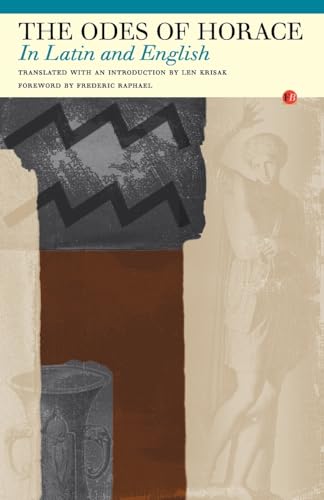
Odes by Horace
Horace (65-8 BC) is the most beguiling of the great Latin poets. He has left an ineradicable mark on Western literature: Dante placed him alongside Homer and Virgil, and his works have been translated and re-imagined since the Renaissance. Len Krisak, an acclaimed poet and translator, provides a close metrical translation of the four books of the Odes and the Centennial Hymn, the first for many years. He translates for the modern reader, combining linguistic precision with an ebullient sense of the possibilities of these inexhaustible works as poems in English. Printed alongside the Latin text, Krisak's translations provide a line-for-line sense of the Latin rhythms, while rendering them in a living English that captures both the wit, tenderness and the occasional irascibility of the great Roman poet. Supporting notes clarify allusions and historical and mythological names. Here Horace's world is made luminously accessible to eye and ear.
"At his bestand this, I think, is the way to go about itKrisak can produce a poem that stands on its ownNo knowledge of the source is necessary." "The Guardian" (UK)"
Quintus Horatius Flaccus, known in English as Horace, was born at Venusia, near the border of Apulia, in 65 B.C. His father, a former slave who had freed himself before the birth of his son, sent him to school in Rome. As a young man Horace went to Athens and studied philosophy at the famous schools. When the Civil War broke out he enlisted in the army of Brutus, served at Philippi, and came back to Rome not long after. Deprived of his property as a result of the proscriptions, he began life anew at the age of twenty-four as a clerk in a public office. Not long after, he attracted the attention of Mecenas, and soon became acquainted with Varius and Virgil, henceforth devoting himself to literary pursuits. HIs first work, the first book of Satires, was published in 35 B.C. About a year later, Mecenas presented him with the celebrated Sabine Farm, and Horace was at liberty to the end of his life to do as he liked. Before he died he was famous: the Emperor Augustus commissioned him to write the fourth book of Odes. He died eight years before the birth of Christ. Len Krisak's most recent books are the Carmina of Catullus (Carcanet Press), Ovid's Erotic Poems (University of Pennsylvania Press), the Eclogues of Virgil (U. of Penn. Press), Horace's Odes (Carcanet), and Rilke's New Poems, 1907-1908 (Boydell & Brewer), all translations. His own work includes Afterimage (Measure Press, University of Evansville), If Anything (Word Press), and Even as We Speak (University of Evansville Press), winner of the Richard Wilbur Poetry Prize. He is also the recipient of the Robert Penn Warren and Robert Frost Prizes in poetry, and with work in the PN, Hudson, Sewanee, Antioch, and Southwest Reviews, is a four-time champion on Jeopardy!
| SKU | Nicht verfügbar |
| ISBN 13 | 9781857548518 |
| ISBN 10 | 1857548515 |
| Titel | Odes |
| Autor | Len Horace |
| Buchzustand | Nicht verfügbar |
| Bindungsart | Paperback |
| Verlag | Carcanet Press Ltd |
| Erscheinungsjahr | 2006-11-30 |
| Seitenanzahl | 180 |
| Hinweis auf dem Einband | Die Abbildung des Buches dient nur Illustrationszwecken, die tatsächliche Bindung, das Cover und die Auflage können sich davon unterscheiden. |
| Hinweis | Nicht verfügbar |