
On Truth and Untruth


On Truth and Untruth
Regular price
Checking stock...
Regular price
Checking stock...
Zusammenfassung
An essay which argues that truth is an illusion. It rejects the idea of universal constants, and claims that what we call truth is only a mobile army of metaphors, metonyms, and anthropomorphisms.
The feel-good place to buy books
- Free delivery in the UK
- Supporting authors with AuthorSHARE
- 100% recyclable packaging
- B Corp - kinder to people and planet
- Buy-back with World of Books - Sell Your Books
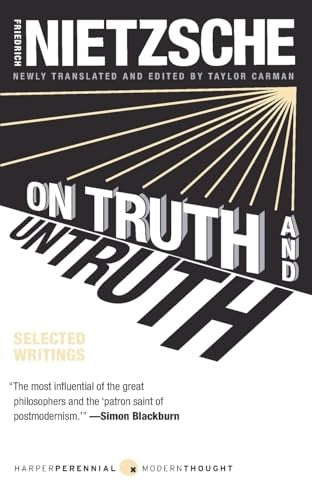
On Truth and Untruth by Friedrich Nietzsche
This is Nietzsche's celebrated essay, in which he argues that truth is an illusion. Those ideas commonly agreed to be truths, according to Nietzsche, are mere beliefs and arbitrary constructions of human thought. From the Stanford Encyclopedia of Philosophy: Scholars regard Nietzsche's 1873 unpublished essay, "On Truth and Lies" [the full title is "On Truth and Lies in a Non-Moral Sense"] as a keystone in his thought. In this essay, Nietzsche rejects the idea of universal constants, and claims that what we call truth is only a mobile army of metaphors, metonyms, and anthropomorphisms. His view at this time is that arbitrariness prevails within human experience: concepts originate via the transformation of nerve stimuli into images, and truth is nothing more than the invention of fixed conventions for practical purposes, especially those of repose, security and consistency. Viewing human existence from a great distance, Nietzsche further notes that there was an eternity before human beings came into existence, and believes that after humanity dies out, nothing significant will have changed in the great scheme of things.
Friedrich Nietzsche was a German philosopher and author. Born into a line of Protestant churchman, Nietzsche studied Classical literature and language before becoming a professor at the University of Basel in Switzerland. He became a philosopher after reading Schopenhauer, who suggested that God does not exist, and that life is filled with pain and suffering. Nietzsche's first work of prominence was The Birth of Tragedy in 1872, which contained new theories regarding the origins of classical Greek culture. From 1883 to 1885 Nietzsche composed his most famous work, Thus Spake Zarathustra, in which he famously proclaimed that "God is dead." He went on to release several more notable works including Beyond Good and Evil and The Genealogy of Morals, both of which dealt with the origins of moral values. Nietzsche suffered a nervous breakdown in 1889 and passed away in 1900, but not before giving us his most famous quote, "From life's school of war: what does not kill me makes me stronger."
| SKU | Nicht verfügbar |
| ISBN 13 | 9780061990465 |
| ISBN 10 | 0061990469 |
| Titel | On Truth and Untruth |
| Autor | Friedrich Nietzsche |
| Serie | Harper Perennial Modern Thought |
| Buchzustand | Nicht verfügbar |
| Bindungsart | Paperback |
| Verlag | HarperCollins Publishers Inc |
| Erscheinungsjahr | 2010-12-01 |
| Seitenanzahl | 176 |
| Hinweis auf dem Einband | Die Abbildung des Buches dient nur Illustrationszwecken, die tatsächliche Bindung, das Cover und die Auflage können sich davon unterscheiden. |
| Hinweis | Nicht verfügbar |