
The Plaston Concept


Proud to be B-Corp
The feel-good place to buy books
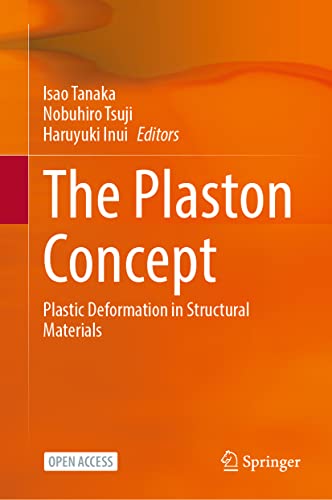
The Plaston Concept by Isao Tanaka
Part I. Introduction.- 1. Plaston induced plasticity in bulk nanostructured metals.- Part II. Simulation of plaston and plaston induced phenomena.- 2. Nucleation of plaston at surface and interface of metallic materials.- 3. Atomistic study of plaston in nanostructured metals.- 4. First principles calculations of collective motion of atoms in metals.- 5. Machine learning interatomic potentials with controlled accuracy.- 6. First principles calculations of dislocation cores in HCP metals.- Part III. Experimental analyses of plaston.- 7. STEM observation of plaston in alumina.- 8. Micro-pillar deformation experiments of brittle intermetallics in steel.- 9. Nano-indentation study of steels.- 10. Synchrotron x-ray study on plaston in metals.- 11. Improvement of fatigue lifetime by controlling plaston at crack tip.- Part IV. Design and development of high performance structural materials.- 12. Development of bulk nanostructured steels.- 13. Design and development of high Mn steels.- 14. Design and development novel magnesium alloys.Nobuhiro Tsuji is a professor in the Department of Materials Science and Engineering at Kyoto University, Japan since 2009, after working as an assistant professor and associate professor in Osaka University, Japan, for 15 years. He is a principal investigatorof the Center for Elements Strategy Initiative for Structural Materials (ESISM), Kyoto University, Japan. His research area is physical and mechanical metallurgy of structural metallic materials including steels and non-ferrous alloys. He has energetically studied structural evolution and mechanical properties of bulk nanostructured metals. He got the 5th JSPS Award from Japan Society for Promotion of Science in 2009, the Lee Hsun Lecture Award from Chinese Academy of Science, Institute for Metals Research in 2018, and so on.
Haruyuki Inui is a professor in the Department of Materials Science and Engineering at Kyoto University in Japan. He has a joint appointment at the Center for Elements Strategy Initiative for Structural Materials (ESISM), Kyoto University, Japan. His research area covers the understanding of fundamentals of mechanical properties in various metallic materials including intermetallics and high-entropy alloys on a wide length-scales basedon dislocation theory. He has served as an editor of the Journal of Intermetallics, an associate editor of the journal of Science and Technology of Advanced Materials, and also President of Japan Institute of Metals and Materials..| SKU | Nicht verfügbar |
| ISBN 13 | 9789811677144 |
| ISBN 10 | 981167714X |
| Titel | The Plaston Concept |
| Autor | Isao Tanaka |
| Buchzustand | Nicht verfügbar |
| Bindungsart | Hardback |
| Verlag | Springer Verlag, Singapore |
| Erscheinungsjahr | 2022-01-26 |
| Seitenanzahl | 278 |
| Hinweis auf dem Einband | Die Abbildung des Buches dient nur Illustrationszwecken, die tatsächliche Bindung, das Cover und die Auflage können sich davon unterscheiden. |
| Hinweis | Nicht verfügbar |