
Plato Opera Volume I


Plato Opera Volume I
Regular price
Checking stock...
Regular price
Checking stock...
Zusammenfassung
This edition contains seven of the dialogues of Plato and is the first in a five-volume complete edition of Plato's works in the "Oxford Classical Texts" series. It represents the latest in textual scholarship. All primary manuscripts have been checked and in most cases, freshly collated.
The feel-good place to buy books
- Free delivery in the UK
- Supporting authors with AuthorSHARE
- 100% recyclable packaging
- B Corp - kinder to people and planet
- Buy-back with World of Books - Sell Your Books
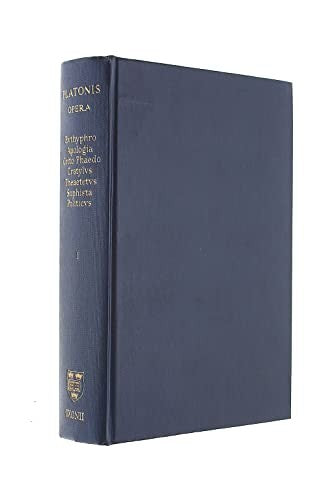
Plato Opera Volume I by E A Duke
Plato is one of the key ancient authors studied by both classicists and philosophers. This volume contains the first eight of Plato's works in the traditional order which appears in most of the manuscripts. The first four, Euthyphro, Apology, Crito, ahd Phaedo are grouped by their dramatic settings concerned with the death of Socrates. The Apology and Crito display Socrates' philosophical mission. The Euthyphro discusses piety; the Phaedo proves the immortality of the soul by appeal to Plato's Theory of Forms. The second group of dialogues represent Plato's later work and are grouped according to his own indications; The Cratylus discusses language, the Thaetetus knowledge, the Sophist being and negation, and the Politicus statesmanship. This new edition offers much additional information on the preservation of Plato's text. All primary manuscripts have been checked and in most casesx freshly cololated. Papyrus fragments recently made available that were unknown to previous editors have been in several cases re-examined and their evidence reported, whilst no less important has been the search for previously unreported quotations of Plato in later Greek writers, facilitated by new editions of Neoplatonic writers. All textual problems have been thought through afresh.
A unified project, and executed with notable editorial consistency.. unless there are major new papyrus finds, or the study of ancient Greek revives, it is unlikely that the world will ever have a better text of Plato than this. * Bryn Mawr Classical Review *
The first volume of the new Platonis Opera has been long desired ... A special feature of this edition is the thoroughness with which it utilizes the evidence of the indirect tradition * Mark Joyal, Memorial Univ of Newfoundland, Hermathena *
No text can satisfy all readers, least of all the text of an author whose meaning has been the subject of fierce argument for almost 2,400 years. But this edition, with its thorough, accurate, and reliable presentation of the evidence, allows the thoughtful user to make his own decisions. It is a worthy successor to Burnet and will be the standard text of the first two tetralogies for a great many years to come. * Mark Joyal, Memorial Univ of Newfoundland, Hermathena *
The first volume of the new Platonis Opera has been long desired ... A special feature of this edition is the thoroughness with which it utilizes the evidence of the indirect tradition * Mark Joyal, Memorial Univ of Newfoundland, Hermathena *
No text can satisfy all readers, least of all the text of an author whose meaning has been the subject of fierce argument for almost 2,400 years. But this edition, with its thorough, accurate, and reliable presentation of the evidence, allows the thoughtful user to make his own decisions. It is a worthy successor to Burnet and will be the standard text of the first two tetralogies for a great many years to come. * Mark Joyal, Memorial Univ of Newfoundland, Hermathena *
Born to a politically connected and aristocratic family between 428 and 423 B.C., Plato received a good standard of education at an early age, and was able to immerse himself in the intellectual community of Ancient Athens. His most notable contemporary and mentor was Socrates, an eccentric but highly capable philosopher who was to feature as a principle character in most of Plato's scholarly writings. Owing to his high standard of education in art, mathematics, rhetoric and philosophy, Plato was able to assemble a comprehensive philosophy of his own via his favoured form of writing which was the dialogue. In total, over thirty of these Platonic dialogues have survived the passage of time - and together they form the backbone of Ancient Greek philosophy. After enjoying success as a writer and academic, Plato in 385 B.C. founded The Academy. This school was to unite the most capable thinkers of Greece, and would help to advance learning throughout Greek society's Golden Age. It was in the Academy that Plato would instruct and apprentice Aristotle, who was to go on to gain renown as a philosopher and scholar. Owing to his reputation Plato was hired by Dion, whose nephew Dionysus II was the rightful ruler of Sicily - Dion wished his nephew to receive a good education in the art of sound and wise governance. However Dionysus II became suspicious and accused both Plato and Dion of conspiracy - after some time spent under arrest, Plato returned to his homeland. In his late period, Plato continued to tutor and mentor the best young minds of Athens, and he would perish around 348 B.C. having lived beyond the age of eighty. Today Plato's legacy remains lauded: the philosopher ably used logic and reason to imbue insight on democratic governance, while developing a cohesive philosophy on topics such as art, metaphysics, justice and the 'Theory of Forms' - his iconic take on how ideas related to reality.
| SKU | Nicht verfügbar |
| ISBN 13 | 9780198145691 |
| ISBN 10 | 0198145691 |
| Titel | Plato Opera Volume I |
| Autor | E A Duke |
| Serie | Oxford Classical Texts |
| Buchzustand | Nicht verfügbar |
| Verlag | Oxford University Press |
| Erscheinungsjahr | 1995-09-14 |
| Seitenanzahl | 604 |
| Hinweis auf dem Einband | Die Abbildung des Buches dient nur Illustrationszwecken, die tatsächliche Bindung, das Cover und die Auflage können sich davon unterscheiden. |
| Hinweis | Nicht verfügbar |