


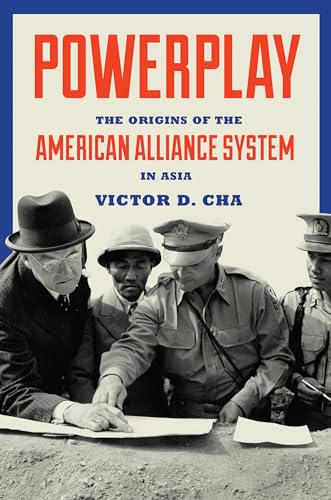
Powerplay by Victor Cha
A close look at the evolution of American political alliances in Asia and their future While the American alliance system in Asia has been fundamental to the region's security and prosperity for seven decades, today it encounters challenges from the growth of China-based regional organizations. How was the American alliance system originally established in Asia, and is it currently under threat? How are competing security designs being influenced by the United States and China? In Powerplay, Victor Cha draws from theories about alliances, unipolarity, and regime complexity to examine the evolution of the U.S. alliance system and the reasons for its continued importance in Asia and the world. Cha delves into the fears, motivations, and aspirations of the Truman and Eisenhower presidencies as they contemplated alliances with the Republic of China, Republic of Korea, and Japan at the outset of the Cold War. Their choice of a bilateral "hub and spokes" security design for Asia was entirely different from the system created in Europe, but it was essential for its time. Cha argues that the alliance system’s innovations in the twenty-first century contribute to its resiliency in the face of China’s increasing prominence, and that the task for the world is not to choose between American and Chinese institutions, but to maximize stability and economic progress amid Asia’s increasingly complex political landscape. Exploring U.S. bilateral relations in Asia after World War II, Powerplay takes an original look at how global alliances are achieved and maintained.
"Powerplay is an illuminating and important book that should help to guide policy makers as they try to cope with the greatest challenge to the American alliance system in Asia since it was created some seven decades ago: the rise of a power, China, that wants to shake it up"---Richard Bernstein, Wall Street Journal
"Cha has embedded a lively narrative of post-World War II diplomatic history inside a thought-provoking analytic framework."---Andrew Nathan, Foreign Affairs
"Masterful. . . . Deft and seamless mixture of theory, historical analysis, and policy prescription."---Ben Rimland, Washington Free Beacon
"Powerplay demonstrates an incredible depth and breadth of knowledge, solid research, and accessible analysis."---Daniel Runde, Foreign Policy
"An important contribution to the literature on alliance politics and regional security in Asia."---Yukari Iwanami, International Relations of the Asia-Pacific
"This book is an important contribution to the literature on alliance politics and regional security in Asia."---Yukari Iwanami, International Relations of the Asia-Pacific
"Timely. . . . It provides a clear-eyed, historical perspective on the emergence, significance and continued relevance of the alliance structure. Cha persuasively argues that security arrangements in Asia possess both a different structure and rationale for their existence than security arrangements in Europe."---Olivia Enos, The National Interest
"Until now, the literature lacked a comprehensive work examining the origins of post-WWII American alliances in Asia. Cha fills this gap. . . . A masterpiece of early Cold War history. . . . Cha successfully persuades readers that the hub and spokes alliance system was not the product of contingencies, but a deliberate choice of the Truman and Eisenhower administrations. . . . What makes this book original and worth reading is the integration of these important monographs and primary documents on the different bilateral alliances into one framework, which is the Powerplay strategy."---Giuseppe Spatafora, The International Spectator
"Victor Cha presents an exciting and original argument. His analysis is convincing, his research thorough, and his writing clear. . . . For anyone looking to understand why the American alliance system in Asia emerged so differently from the one in Europe, Powerplay should be required reading."---Mitchell Lerner, Michigan War Studies Review
"Cha has embedded a lively narrative of post-World War II diplomatic history inside a thought-provoking analytic framework."---Andrew Nathan, Foreign Affairs
"Masterful. . . . Deft and seamless mixture of theory, historical analysis, and policy prescription."---Ben Rimland, Washington Free Beacon
"Powerplay demonstrates an incredible depth and breadth of knowledge, solid research, and accessible analysis."---Daniel Runde, Foreign Policy
"An important contribution to the literature on alliance politics and regional security in Asia."---Yukari Iwanami, International Relations of the Asia-Pacific
"This book is an important contribution to the literature on alliance politics and regional security in Asia."---Yukari Iwanami, International Relations of the Asia-Pacific
"Timely. . . . It provides a clear-eyed, historical perspective on the emergence, significance and continued relevance of the alliance structure. Cha persuasively argues that security arrangements in Asia possess both a different structure and rationale for their existence than security arrangements in Europe."---Olivia Enos, The National Interest
"Until now, the literature lacked a comprehensive work examining the origins of post-WWII American alliances in Asia. Cha fills this gap. . . . A masterpiece of early Cold War history. . . . Cha successfully persuades readers that the hub and spokes alliance system was not the product of contingencies, but a deliberate choice of the Truman and Eisenhower administrations. . . . What makes this book original and worth reading is the integration of these important monographs and primary documents on the different bilateral alliances into one framework, which is the Powerplay strategy."---Giuseppe Spatafora, The International Spectator
"Victor Cha presents an exciting and original argument. His analysis is convincing, his research thorough, and his writing clear. . . . For anyone looking to understand why the American alliance system in Asia emerged so differently from the one in Europe, Powerplay should be required reading."---Mitchell Lerner, Michigan War Studies Review
Victor D. Cha is D. S. Song-Korea Foundation Endowed Chair in the Department of Government and School of Foreign Service at Georgetown University. He is senior adviser and Korea chair at the Center for Strategic and International Studies and was director for Asian affairs at the National Security Council from 2004 to 2007. His books include The Impossible State: North Korea, Past and Future (2012). David C. Kang is Maria Crutcher Professor of International Relations, Business, and East Asian Languages and Cultures at the University of Southern California, where he is also director of the Korean Studies Institute and the Center for International Studies. His most recent book is American Grand Strategy and East Asian Security in the Twenty-First Century (2017). Stephan Haggard is the Lawrence and Sallye Krause Professor of Korea-Pacific Studies, director of the Korea-Pacific Program, and distinguished professor of political science at the School of Global Policy and Strategy at the University of California, San Diego. His books include Hard Target: Sanctions, Inducements, and the Case of North Korea (2017).
| SKU | Nicht verfügbar |
| ISBN 13 | 9780691180946 |
| ISBN 10 | 0691180946 |
| Titel | Powerplay |
| Autor | Victor Cha |
| Serie | Princeton Studies In International History And Politics |
| Buchzustand | Nicht verfügbar |
| Bindungsart | Paperback |
| Verlag | Princeton University Press |
| Erscheinungsjahr | 2018-04-24 |
| Seitenanzahl | 352 |
| Hinweis auf dem Einband | Die Abbildung des Buches dient nur Illustrationszwecken, die tatsächliche Bindung, das Cover und die Auflage können sich davon unterscheiden. |
| Hinweis | Nicht verfügbar |