
Re-Humanising Shakespeare


Zusammenfassung
The feel-good place to buy books
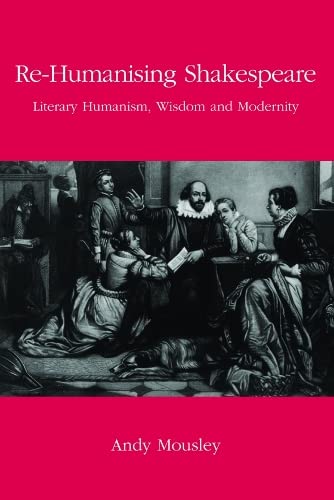
Re-Humanising Shakespeare by Andrew Mousley
Re-Humanising Shakespeare argues that although Shakespeare himself contributed to the uncertainties of modern living, his work can still serve as a source of existential wisdom and guidance.
Can 'a literary humanism ! based on the possibility of human beings living better lives ! survive irony, pessimism and disenchantment[?]' Mousley asks (p164). His book helps us answers this question in the affirmative. Re-Humanising Shakespeare thus adds to a debate about the status of the human in Shakespeare's plays, but does so, significantly, by declining to caricature either side of the debate. Mousley is willing to listen to anti-foundationalists as well as foundationalists, to sceptics as well as believers. In this - in his respect for others and their voices - he clearly practices what his book preaches. -- Douglas Bruster, Issue 90:1 (2009) English Studies: A Journal of English Language and Literature An absorbing book, in which issues of what it means to be 'human' and 'how to live' are explored through sage and timely readings of Shakespeare's plays ! While this book leads its readers to think about Shakespeare afresh in terms of 'literary humanism', and away from a critical tradition often scathing about the very word 'human', the benefit of this thoughtful and well-crafted book is obvious from the outset: Re-Humanising Shakespeare returns us to a reinvigorated idea of why we read and think about literature, not just by 're-humanising' Shakespeare but by reminding us that Shakespearean drama possesses a powerful capacity to 're-humanise' us. -- Michael Davies, Issue 27:1 (2010) The Society for Renaissance Studies SRS Bulletin Can 'a literary humanism ! based on the possibility of human beings living better lives ! survive irony, pessimism and disenchantment[?]' Mousley asks (p. 164). His book helps us answers this question in the affirmative. Re-Humanising Shakespeare thus adds to a debate about the status of the human in Shakespeare's plays, but does so, significantly, by declining to caricature either side of the debate. Mousley is willing to listen to anti-foundationalists as well as foundationalists, to sceptics as well as believers. In this - in his respect for others and their voices - he clearly practices what his book preaches. An absorbing book, in which issues of what it means to be 'human' and 'how to live' are explored through sage and timely readings of Shakespeare's plays ! While this book leads its readers to think about Shakespeare afresh in terms of 'literary humanism', and away from a critical tradition often scathing about the very word 'human', the benefit of this thoughtful and well-crafted book is obvious from the outset: Re-Humanising Shakespeare returns us to a reinvigorated idea of why we read and think about literature, not just by 're-humanising' Shakespeare but by reminding us that Shakespearean drama possesses a powerful capacity to 're-humanise' us.
Andrew Mousley is Senior Lecturer in English at De Montfort University, Leicester. He is the author of Critical Humanisms (2003, with Martin Halliwell), Renaissance Drama and Contemporary Literary Theory (2000) and the editor of New Casebooks: John Donne (1999). He is the co-editor of the Edinburgh Critical Guides to Literature series.
| SKU | Nicht verfügbar |
| ISBN 13 | 9780748623181 |
| Titel | Re-Humanising Shakespeare |
| Autor | Andy Mousley |
| Buchzustand | Nicht verfügbar |
| Bindungsart | Hardback |
| Verlag | Edinburgh University Press |
| Erscheinungsjahr | 2007-06-20 |
| Seitenanzahl | 224 |
| Hinweis auf dem Einband | Die Abbildung des Buches dient nur Illustrationszwecken, die tatsächliche Bindung, das Cover und die Auflage können sich davon unterscheiden. |
| Hinweis | Nicht verfügbar |