
Rich Languages From Poor Inputs


Zusammenfassung
The feel-good place to buy books
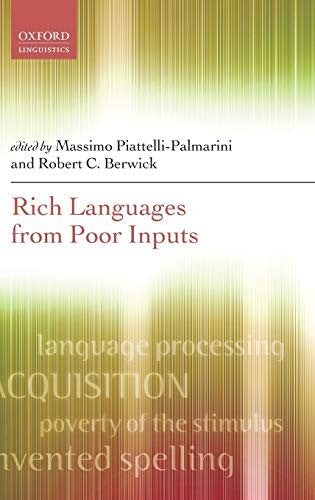
Rich Languages From Poor Inputs by Massimo Piattelli-Palmarini
This book addresses one of the most famous and controversial arguments in the study of language and mind, the Poverty of the Stimulus. Presented by Chomsky in 1968, the argument holds that children do not receive enough evidence to infer the existence of core aspects of language, such as the dependence of linguistic rules on hierarchical phrase structure. The argument strikes against empiricist accounts of language acquisition and supports the conclusion that knowledge of some aspects of grammar must be innate. In the first part of Rich Grammars from Poor Inputs, contributors consider the general issues around the POS argument, review the empirical data, and offer new and plausible explanations. This is followed by a discussion of the the processes of language acquisition, and observed 'gaps' between adult and child grammar, concentrating on the late spontaneous acquisition by children of some key syntactic principles, basically, though not exclusively, between the ages of 5 to 9. Part 3 widens the horizon beyond language acquisition in the narrow sense, examining the natural development of reading and writing and of the child's growing sensitivity for the fine arts.
Rich Languages is an unusual book, assembled as a homage to an unusual woman.. The various outstanding contributors to this volume ... are some of the leaders of the generative enterprise. They seamlessly converge on a rich narrative that is cohesive and engaging - a real page-turner. The convergence is itself a testament to the impact of her pioneering path. * Iris Berent, Language *
offers a very comprehensive and detailed overview of the state of current POS research and offers great insight into POS problems currently under investigation in the field of language acquisition. * Melissa Whatley, Linguist List *
offers a very comprehensive and detailed overview of the state of current POS research and offers great insight into POS problems currently under investigation in the field of language acquisition. * Melissa Whatley, Linguist List *
Massimo Piattelli-Palmarini is Professor of Cognitive Science at the University of Arizona and a member of the Department of Linguistics, the Cognitive Science Program and the Department of Psychology. In October 1975 he organized the encounter between Jean Piaget and Noam Chomsky and in 1980 edited the proceedings Language and Learning, now translated into 11 languages and the echoes of which still explicitly resonate in the present volume. He is the editor, with Juan Uriagereka and Pello Salaburu, of Of Minds and Language: A Dialogue with Noam Chomsky in the Basque Country (OUP) and author, with Jerry Fodor, of What Darwin Got Wrong. Robert C. Berwick is Professor of Computer Science and Computational Linguistics at the Massachusetts Institute of Technology. He has published more than a half-dozen books on the nature of language, language learnability, and computation, starting from his 1982 dissertation, The Acquisition of Syntactic Knowledge to The Grammatical Basis of Linguistic Performance, Computational Complexity and Natural Language, and Principle-Based Parsing. Most recently, he has focused on the biology of language, particularly the evolution of language.
| SKU | Nicht verfügbar |
| ISBN 13 | 9780199590339 |
| ISBN 10 | 0199590338 |
| Titel | Rich Languages From Poor Inputs |
| Autor | Massimo Piattelli-Palmarini |
| Buchzustand | Nicht verfügbar |
| Bindungsart | Hardback |
| Verlag | Oxford University Press |
| Erscheinungsjahr | 2012-12-06 |
| Seitenanzahl | 328 |
| Hinweis auf dem Einband | Die Abbildung des Buches dient nur Illustrationszwecken, die tatsächliche Bindung, das Cover und die Auflage können sich davon unterscheiden. |
| Hinweis | Nicht verfügbar |