
The Road to Galaxy Formation


The Road to Galaxy Formation
Zusammenfassung
This book discusses the beginnings of the process of galaxy formation from cosmological observations and calculations. It also considers the broad features of galaxies that we need to explain and what we know of their later history.
The feel-good place to buy books
- Free delivery in the UK
- Supporting authors with AuthorSHARE
- 100% recyclable packaging
- B Corp - kinder to people and planet
- Buy-back with World of Books - Sell Your Books
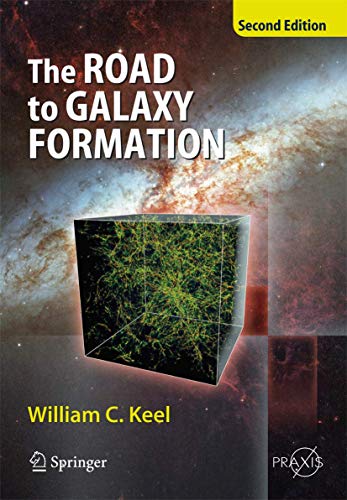
The Road to Galaxy Formation by William C Keel
The formation of galaxies is one of the greatest puzzles in astronomy, the solution is shrouded in the depths of space and time, but has profound implications for the universe we observe today. The book discusses the beginnings of the process from cosmological observations and calculations, considers the broad features of galaxies that we need to explain and what we know of their later history. The author compares the competing theories for galaxy formation and considers the progress expected from new generations of powerful telescopes both on earth and in space. In this second edition the author has retained the observationally-based approach of the first edition, a feature which was particularly well-reviewed: Writing in Nature, Carlton Baugh noted in February 2003 that “It is refreshing, in a market dominated by theorists, to come across a book on galaxy formation written from an observational perspective. The Road to Galaxy Formation should prove to be a handy primer on observations for graduate students, advanced undergraduates and theorists who feel too shy to visit a telescope”. The New Scientist wrote in March 2003: “William Keel delicately balances observational evidence against today's relevant theoretical possibilities”. And Sepehr Arbabi-Bidgoli wrote in Astronomische Nachrichten that “Reading this book I often felt like sitting in an exciting and entertaining lecture given by an astronomer who knows the subject and knows how to present it to the audience”. A Bibliography at the end of each chapter contains a resumé of books, selected research papers and Web resources providing guidance to further reading.From the reviews of the second edition:
"The work is clearly a labor of loveIt immerses the reader in a thorough explanation of the latest data from modern ground- and space-based observatories. From Hubble’s original galaxy classification system to the standard cosmological model, it is all here. This is a well-organized, well-placed, and thoroughly referenced ‘golden review’ of galactic formation and evolution--a must have for any serious student or scientist in the field. Summing Up: Essential. Upper-division undergraduate through professional collections." (T. D. Oswalt, CHOICE, Vol. 45 (8), 2008)
"Keel explores in this book … that the assembly of galaxies as we now see them has occurred continuously over the past 12 or 13 Gyr and can be studied in at least two ways: by looking far back, at large redshifts, and by winkling out the oldest stars surviving in the Milky Way and other nearby galaxies. … Keel’s style is conversational; indeed the book is delightfully written, and the annotations to the bibliographic items pithy and informative." (Virginia Trimble, The Observatory, Vol. 128 (1203), 2008)
Dr. Terry D. Oswalt, an astronomer, is Head of the Department of Physics and Space Sciences and Associate Provost for Research at Florida Institute of Technology. He has also served the U.S. National Science Foundation as program officer for Stellar Astronomy and Astrophysics. He earned his Ph.D. in Astronomy at The Ohio State University specializing in photoelectric and spectroscopic studies of binary star systems, late stages of stellar evolution, minor planets, and comets.
Since coming to Florida Tech in 1982, Dr. Oswalt has taught astronomy and physics, while continuing his primary research interest in studies of collapsed stars called white dwarfs. Because such objects are very faint, this work often takes him to Kitt Peak National Observatory in Arizona, Cerro Tololo Inter-American Observatory in Chile, and Mauna Kea Observatory in Hawaii, where telescopes as large as 10-meters are available on a competitive basis to scientists.
Oswalt is the founding Chairman of the Southeast Association for Research in Astronomy, a consortium of 10 universities which operates an automated 1-meter telescope at Kitt Peak National Observatory near Tucson, Arizona. In 2007 SARA will assume operations of a similar telescope at Cerro Tololo Interamerican Observatory in Chile. Oswalt also has been director of the SARA summer internship program, which brings undergraduate students from around the U.S. to the SARA facility at Kitt Peak each summer to do research in astronomy. Dr. Oswalt has written over 100 scientific articles and edits the I.A.P.P.P. Communications, an international journal for advanced amateurs, students, teachers and professionals who collaborate on research and educational projects in astronomy. He is also the editor for a three-volume set of Springer books, The Future of Small Telescopes in the New Millennium.
William C. Keel is Professor of Astronomy at the University of Alabama in Tuscaloosa. His astronomical interests began as a youngster using a secondhand reflector in the back yard, and he remains active as an amateur as well as professional astronomer. His undergraduate work was at Vanderbilt University, followed by a Ph.D. from the University of California, Santa Cruz. Dr. Keel had postdoctoral positions at Kitt Peak National Observatory and at Leiden, before taking up a faculty position in Alabama.His research interests span the galaxies - active galactic nuclei, galaxy interactions and evolution, dust in galaxies. Observationally oriented, his work has used spectral bands from the radio to the X-ray regimes, with the strongest emphasis in the optical and ultraviolet.These results have been reported in 150 refereed papers. In recent years, much of his work has been tied to the enormously successful Galaxy Zoo citizen-science project. He continues to have scheduling responsibilities for the two telescopes of the SARA consortium, and has served on numerous NASA review panels including two Senior Reviews. Dr. Keel has been active in outreach beyond the formal classroom, through magazine articles, an online presence in several discussion forums, and webcomics explaining ongoing Hubble Space Telescope programs. He has written a technical monograph, The Road to Galaxy Formation, and the nontechnical volumeThe Sky at Einstein's Feet tracing the impact of relativity throughout astronomy.
| SKU | Nicht verfügbar |
| ISBN 13 | 9783540725343 |
| ISBN 10 | 3540725342 |
| Titel | The Road to Galaxy Formation |
| Autor | William C Keel |
| Serie | Astronomy And Planetary Sciences |
| Buchzustand | Nicht verfügbar |
| Bindungsart | Hardback |
| Verlag | Springer-Verlag Berlin and Heidelberg GmbH & Co. KG |
| Erscheinungsjahr | 2007-06-12 |
| Seitenanzahl | 262 |
| Hinweis auf dem Einband | Die Abbildung des Buches dient nur Illustrationszwecken, die tatsächliche Bindung, das Cover und die Auflage können sich davon unterscheiden. |
| Hinweis | Nicht verfügbar |