
Self-Organizing Federalism


Self-Organizing Federalism
Regular price
Checking stock...
Regular price
Checking stock...
Zusammenfassung
This book focuses on institutional collective action (ICA) dilemmas and the institutions developed by affected governments and interests to mitigate them. Feiock and Scholz apply the ICA framework to explore the critical role of these self-organizing institutions in the context of federalism, urban governance, and regional management.
The feel-good place to buy books
- Free delivery in the UK
- Supporting authors with AuthorSHARE
- 100% recyclable packaging
- B Corp - kinder to people and planet
- Buy-back with World of Books - Sell Your Books
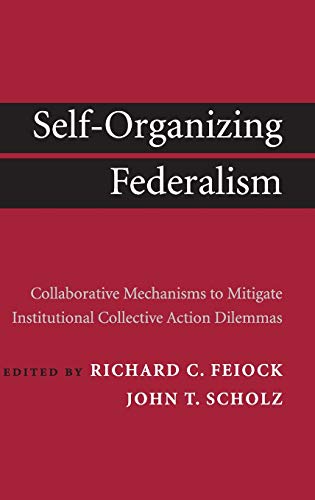
Self-Organizing Federalism by Richard C Feiock
This book investigates the self-organizing responses of governments and interests to the institutional collective action (ICA) dilemmas of particular concern to students of federalism, urban governance, and regional management of natural resources. ICA dilemmas arise in fragmented systems whenever decisions by one independent formal authority do not consider costs or benefits imposed on others. The ICA framework analyzes networks, joint projects, partnerships, and other mechanisms developed by affected parties to mitigate ICA decision externalities. These mechanisms play a widespread role in federalist systems by reshaping incentives to encourage coordination/cooperation. The empirical studies of urban service delivery and regional integration of regional resource management address three questions: How does a given mechanism mitigate costs of uncoordinated decisions? What incentives do potential members have to create the mechanism? How do incentives induced by the mitigating mechanism affect its sustainability in a changing environment and its adaptability to other ICA dilemmas?
'Feiock and Scholz are on their way to doing for intergovernmental relations what Elinor Ostrom has done for common pool resource management: helping us understand how externalities can be overcome through bottom-up, local solutionsThese remedies often surpass centrally provided solutions because they are designed to fit local needs, traditions, and capacities. The contributed chapters fill out the theory well and offer excellent examples of the variety of homegrown solutions. Those who set policy as well as those who study it will find much of interest in this unique volume.' Jenna Bednar, University of Michigan
'Today's policy problems cannot be solved by analysts recommending one solution for all problems based on narrow disciplinary viewpoints. Most policy problems are multi-level where solutions that work at one level, or for one problem, do not work at other levels or for other problems. This book analyzes multiple solutions without getting lost in chaos. An essential read!' Elinor Ostrom, Indiana University
'How can we encourage collaborative action in formally decentralized governance settings? Which of many possible institutional arrangements among local governments and agencies offers the best match for a particular policy challenge? How can we make sense of the myriad collaborative possibilities - networks, contracts, partnerships, and the like? Self-Organizing Federalism makes a significant contribution by offering needed and welcome answers.' Laurence J. O'Toole, Jr, University of Georgia
'The authors have produced an intelligent, accessible, and academic agenda-setting volume worthy of wide readership.' Mark Rhinard, Public Administration
'Today's policy problems cannot be solved by analysts recommending one solution for all problems based on narrow disciplinary viewpoints. Most policy problems are multi-level where solutions that work at one level, or for one problem, do not work at other levels or for other problems. This book analyzes multiple solutions without getting lost in chaos. An essential read!' Elinor Ostrom, Indiana University
'How can we encourage collaborative action in formally decentralized governance settings? Which of many possible institutional arrangements among local governments and agencies offers the best match for a particular policy challenge? How can we make sense of the myriad collaborative possibilities - networks, contracts, partnerships, and the like? Self-Organizing Federalism makes a significant contribution by offering needed and welcome answers.' Laurence J. O'Toole, Jr, University of Georgia
'The authors have produced an intelligent, accessible, and academic agenda-setting volume worthy of wide readership.' Mark Rhinard, Public Administration
Richard C. Feiock's current research on the roles of networks and local institutions in land use governance is supported by the National Science Foundation and the Lincoln Institute of Land Policy. His previous books include Institutional Constraints and Local Government (2001), City-County Consolidation and Its Alternatives (2004), and Metropolitan Governance: Conflict, Competition and Cooperation (2004). His work appears in leading journals, including Public Administration Review, Journal of Public Administration Research and Theory, Journal of Politics, and the American Journal of Political Science. John T. Scholz's current research analyzes the problems of developing and maintaining cooperative solutions to collective action problems, emphasizing the role of policy networks, private partnerships, and collaborative government programs in resolving collective problems involved in resource management. His work has been supported by numerous grant awards from the National Science Foundation and appears in leading journals, including the American Journal of Political Science, the Journal of Politics, and the American Political Science Review. He co-edited Adaptive Governance and Water Conflict (with Bruce Stiftel, 2005).
| SKU | Nicht verfügbar |
| ISBN 13 | 9780521764933 |
| ISBN 10 | 0521764939 |
| Titel | Self-Organizing Federalism |
| Autor | Richard C Feiock |
| Buchzustand | Nicht verfügbar |
| Verlag | Cambridge University Press |
| Erscheinungsjahr | 2009-10-26 |
| Seitenanzahl | 368 |
| Hinweis auf dem Einband | Die Abbildung des Buches dient nur Illustrationszwecken, die tatsächliche Bindung, das Cover und die Auflage können sich davon unterscheiden. |
| Hinweis | Nicht verfügbar |