
Speaking to the Rose


Zusammenfassung
The feel-good place to buy books
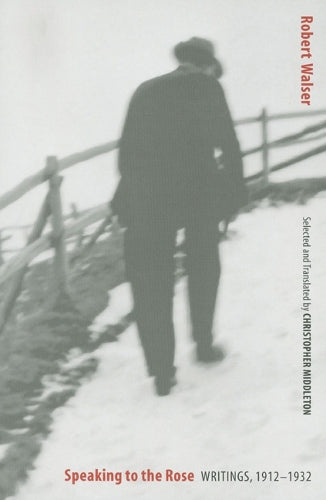
Speaking to the Rose by Robert Walser
The Swiss writer of whom Hermann Hesse famously declared, “If he had a hundred thousand readers, the world would be a better place,” Robert Walser (1878–1956) is only now finding an audience among English-speaking readers commensurate with his merits—if not with his self-image. After a wandering, precarious life during which he produced poems, essays, stories, and novels, Walser entered an insane asylum, saying, “I am not here to write, but to be mad.” Many of the unpublished works he left were in fact written in an idiosyncratically abbreviated script that was for years dismissed as an impenetrable private cipher. Fourteen texts from these so-called pencil manuscripts are included in this volume—rich evidence that Walser’s microscripts, rather than the work of incipient madness, were in actuality the product of desperate genius building a last reserve, and as such, a treasure in modern literature. With a brisk preface and a chronology of Walser’s life and work, this collection of fifty translations of short prose pieces covers the middle to later years of the writer’s oeuvre. It provides unparalleled insight into Walser’s creative process, along with a unique opportunity to experience the unfolding of his rare and eccentric gift. His novels The Robber (Nebraska 2000) and Jakob von Gunten are also available in English translation.
“Middleton translates to perfection both the text and the spirit. . . Walser’s central themes of self-effacement, the primacy of the imagination, the liberating aim of creative play are richly displayed in the new volume. You’ll find both the Walser deadpan . . . and his pratfall. . . . . Walser’s lightness is lighter than light, buoyant up to and beyond belief, terrifyingly light. At times, he seems closer to writers like the French poet Francis Ponge than to his 'weightier' peers such as Musil, Broch, or Mann. Both Ponge and Walser, through an almost phenomenological parsing and shedding of received notions, reveal the uniqueness of insignificant things. In his insignificance, Walser was among the sovereign.”—Bookforum
“Journals (and the contemporary malady of journalishness) are full of solitude and feigned humility, as small as personal; Walser's microtexts are the opposite. Or, small script = large human. Smallness makes text liquid, lose-able, ubiquitous. Walser is a scale explosion.”—Trisha Donnelly, Artforum International
“Splendidly translated by the inestimable Christopher Middleton, a poet and champion of Walser’s. . . . They remind us of the pleasure of his keen eye, his alert imagination, and his lyric voice.”—Joseph Dewey, Review of Contemporary Fiction
“A little gem. . . . Christopher Middleton has translated and introduced a selection of Walser’s strange scribbles, including many from his pre-asylum period. . . . What a find.”—George Fetherling, New Brunswick Reader
“Journals (and the contemporary malady of journalishness) are full of solitude and feigned humility, as small as personal; Walser's microtexts are the opposite. Or, small script = large human. Smallness makes text liquid, lose-able, ubiquitous. Walser is a scale explosion.”—Trisha Donnelly, Artforum International
“Splendidly translated by the inestimable Christopher Middleton, a poet and champion of Walser’s. . . . They remind us of the pleasure of his keen eye, his alert imagination, and his lyric voice.”—Joseph Dewey, Review of Contemporary Fiction
“A little gem. . . . Christopher Middleton has translated and introduced a selection of Walser’s strange scribbles, including many from his pre-asylum period. . . . What a find.”—George Fetherling, New Brunswick Reader
ROBERT WALSER (1878-1956) was born into a German-speaking family in Biel, Switzerland. He left school at fourteen and led a wandering, precarious existence while writing his poems, novels, and vast numbers of the prose pieces that became his hallmark. In 1933 he was confined to a sanatorium, which marked the end of his writing career. Among Walser's works available in English are Jakob von Gunten (available as an NYRB classic), The Tanners, Microscripts, The Assistant, The Robber, Masquerade and Other Stories, and Speaking to the Rose: Writings, 1912-1932. JOCHEN GREVEN is the author of first German-language PhD dissertation on Robert Walser and the editor of Walser's collected works in German. As a graduate student in the 1950s, he recognized that Walser's microscripts (manuscript pages covered with tiny handwriting discovered after Walser's death) were not written in secret code but were in fact literary texts in standard German. Greven has devoted more than fifty years to studying and editing Walser's work. SUSAN BERNOFSKY is the translator of six books by Robert Walser as well as works by Jenny Erpenbeck, Yoko Tawada, Hermann Hesse, Gregor von Rezzori, and others. The current chair of the PEN Translation Committee, she teaches in the MFA Program in Creative Writing and Literary Translation at Queens College (CUNY) and is at work on a biography of Walser.
| SKU | Nicht verfügbar |
| ISBN 13 | 9780803298330 |
| ISBN 10 | 0803298331 |
| Titel | Speaking to the Rose |
| Autor | Robert Walser |
| Buchzustand | Nicht verfügbar |
| Bindungsart | Paperback |
| Verlag | University of Nebraska Press |
| Erscheinungsjahr | 2005-09-01 |
| Seitenanzahl | 134 |
| Hinweis auf dem Einband | Die Abbildung des Buches dient nur Illustrationszwecken, die tatsächliche Bindung, das Cover und die Auflage können sich davon unterscheiden. |
| Hinweis | Nicht verfügbar |