
Two Kingdoms, Two Loyalties


Zusammenfassung
The feel-good place to buy books
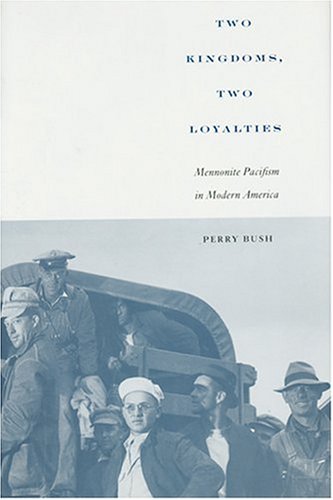
Two Kingdoms, Two Loyalties by Perry Bush
For over 300 years, Mennonites adhered to a strict two-kingdom theology, owing their supreme adherence to the divine kingdom whole serving as loyal, law-abiding subjects to the state in all matters that did not contradict their religious beliefs. Traditionally, Mennonites saw affairs of state as none of their business. In times of war, the Mennonite church counselled conscientious objection and spoke against military participation in either combatant or non-combatant roles. Mennonites did not serve in coercive government offices, most refused to vote or sue in courts of law and held a generally negative view of expressions of political protest to government authorities. During World War II, however, the voluntary participation of Mennonites in conscientious objector labour camps pulled Mennonite youth out of rural isolation and raised their awareness of America's social ills and their own responsibilities as Christians. In the post-war era, Mennonites were no longer "the quiet in the land", but began to articulate publicly their concerns about such issues as the draft, the civil rights movement and the Vietnam war. In this study, the author explores the dramatic changes both within Mennonite communities and in their relationship with mainstream American society between the 1920s and the 1970s, as Mennonite society and culture underwent a profound transformation from seclusion to nearly complete acculturation. Congruent with their entrance into national society, Mennonites began to engage the state on a number of new issues which an older theological and behavioural tradition had previously defined as outside their sphere of concern. Bush notes that as was the case in mainstream society, it was primarily the church's youth who were the most passionately involved in the struggle to speak out against war and other concerns.
"Well written and persuasive, 'Two Kingdoms, Two Loyalties' is a genuinely useful workBush uses the changing Mennonite response to the twentieth-century American warfare state to describe how Mennonites shifted from a predominantly rural, sectarian, and conservative religious community to an urban, middle-class religious community and remained substantially intact, despite the wrenching social and cultural changes they lived through. This is the first scholarly work to analyze how Mennonites have interacted with the larger American society over the entire span of the twentieth century."--Albert N. Keim, Eastern Mennonite University "Professor Bush tells the fascinating story of Mennonite Pacifists in 20th century America. Anchored on excellent historical documentation, this creative interpretation takes us inside the Mennonite community as it struggles to preserve and practice its cherished beliefs in a pluralistic society. This is a creative and excellent contribution to our understanding of minority communities in American society."--Donald B. Kraybill, Messiah College
Perry Bush is associate professor of history at Bluffton College.
| SKU | Nicht verfügbar |
| ISBN 13 | 9780801858277 |
| ISBN 10 | 0801858275 |
| Titel | Two Kingdoms, Two Loyalties |
| Autor | Perry Bush |
| Buchzustand | Nicht verfügbar |
| Verlag | Johns Hopkins University Press |
| Erscheinungsjahr | 1998-10-07 |
| Seitenanzahl | 376 |
| Hinweis auf dem Einband | Die Abbildung des Buches dient nur Illustrationszwecken, die tatsächliche Bindung, das Cover und die Auflage können sich davon unterscheiden. |
| Hinweis | Nicht verfügbar |