
What Makes Nature Tick?


Zusammenfassung
The feel-good place to buy books
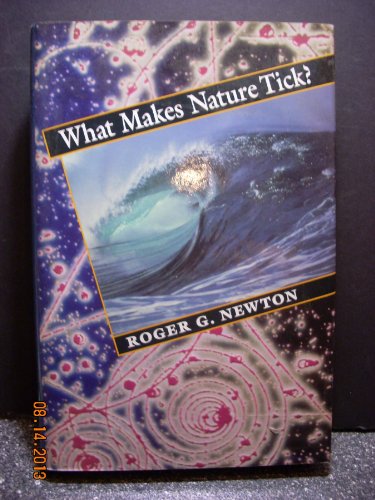
What Makes Nature Tick? by Roger G Newton
This account of how physicists understand the world, explores both the mysteries of the universe, and the beauty of the science that gives shape to the unseeable. The author discusses solitons and superconductors, quarks and strings, phase space, tachyons, time, chaos, and indeterminacy, as well as the investigations that have led to their elucidation. However, he does not limit this volume to recent discoveries and startling facts. He strives to presents physics as an intellectual structure, a network of ideas that stretches back 300 years. Where does our unidirectional sense of time come from? How are forces transmitted through empty space? What is an elementary particle? In addition to providing answers to these questions, and many others, Newton demonstrates how physicists formulate the questions - a process upon which intuition, imagination, and aesthetics have a surprisingly powerful influence.
Newton, Roger G.: - Roger G. Newton is Distinguished Professor Emeritus of Physics at Indiana University.
| SKU | Nicht verfügbar |
| ISBN 13 | 9780674950856 |
| ISBN 10 | 0674950852 |
| Titel | What Makes Nature Tick? |
| Autor | Roger G Newton |
| Buchzustand | Nicht verfügbar |
| Bindungsart | Hardback |
| Verlag | Harvard University Press |
| Erscheinungsjahr | 1993-01-01 |
| Seitenanzahl | 270 |
| Hinweis auf dem Einband | Die Abbildung des Buches dient nur Illustrationszwecken, die tatsächliche Bindung, das Cover und die Auflage können sich davon unterscheiden. |
| Hinweis | Nicht verfügbar |