
An Analysis of Michel Foucault's What is an Author?


An Analysis of Michel Foucault's What is an Author?
Regular price
Checking stock...
Regular price
Checking stock...
Zusammenfassung
Foucault's 1969 essay What is an Author? applies the same approach to the central figure of literary criticism: the author, asking, against the grain of our intuitions, whether an “author” is truly the real individual who writes a text, or something else.
The feel-good place to buy books
- Free delivery in the UK
- Supporting authors with AuthorSHARE
- 100% recyclable packaging
- B Corp - kinder to people and planet
- Buy-back with World of Books - Sell Your Books
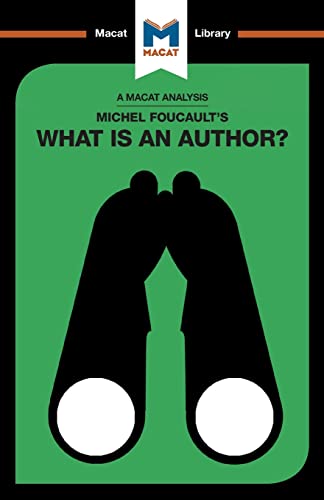
An Analysis of Michel Foucault's What is an Author? by Tim Smith-Laing
Michel Foucault’s 1969 essay “What is an Author?” sidesteps the stormy arguments surrounding “intentional fallacy” and the “death of the author,” offering an entirely different way of looking at texts. Foucault points out that all texts are written but not all are discussed as having “authors”. So what is special about “authored” texts? And what makes an “author” different to other kinds of text-producers? From its deceptively simple titular question, Foucault’s essay offers a complex argument for viewing authors and their texts as objects. A challenging, thought-provoking piece, it is one of the most influential literary essays of the twentieth century.Dr Tim Smith-Laing took his DPhil in English literature at Merton College, Oxford, and has held positions at Jesus College, Oxford, and Sciences Po in Paris.
| SKU | Nicht verfügbar |
| ISBN 13 | 9781912453085 |
| ISBN 10 | 1912453088 |
| Titel | An Analysis of Michel Foucault's What is an Author? |
| Autor | Tim Smith-Laing |
| Serie | The Macat Library |
| Buchzustand | Nicht verfügbar |
| Bindungsart | Paperback |
| Verlag | Macat International Limited |
| Erscheinungsjahr | 2018-05-15 |
| Seitenanzahl | 112 |
| Hinweis auf dem Einband | Die Abbildung des Buches dient nur Illustrationszwecken, die tatsächliche Bindung, das Cover und die Auflage können sich davon unterscheiden. |
| Hinweis | Nicht verfügbar |