
Attention and Interpretation


Attention and Interpretation
Regular price
Checking stock...
Regular price
Checking stock...
Zusammenfassung
Bion argues that for the study of people - whether individually or in groups - accurate observation is essential. Problems of language are given careful consideration, and an attempt is made to show how certain psychological problems can be usefully compared with mathematical formulations.
The feel-good place to buy books
- Free delivery in the UK
- Supporting authors with AuthorSHARE
- 100% recyclable packaging
- B Corp - kinder to people and planet
- Buy-back with World of Books - Sell Your Books
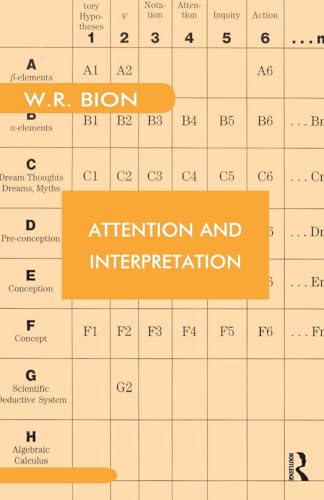
Attention and Interpretation by Wilfred R Bion
Celtic symbols were created by the Celts, a race of tribes, who lived in settlements across Europe, from Ireland to Turkey, notably during the Iron Age. Evidence of their culture reaches back further than 1200 BC. These people were thought to have a common language and shared systems of belief, despite living far and wide and they are believed to have been both traders and warriors. While they did not initially have a written language, they did create metal and stone work with patterns that are recognisable today as Celtic symbols. These shapes and patterns have been influenced by different religions, beliefs and cultures ever since, such as Druids and Christians. As a result, when we look at the symbols, there are often more than one variation of the same symbol, and similarly, often more than one meaning attached to it. This book is perfect for people new to the subject of Celtic symbology, with illustrations, relevant meanings and descriptions of the many myths and legends attached to them.
Bion's central thesis in this volume is that for the study of people, whether individually or in groups, a cardinal requisite is accurate observation, accompanied by accurate appreciation and formulation of the observations so madeThe study represents a further development of a theme introduced in the author's earlier works, particularly in Elements of Psychoanalysis (1963) and Transformations (1965). Bion's concern with the subject stems directly from his psycho-analytic experience and reflects his endeavor to overcome, in a scientific frame of reference, the immense difficulty of observing, assessing, and communicating non-sensuous experience.Here, he lays emphasis on he overriding importance of attending to the realities of mental phenomena as they manifest themselves in the individual or group under study. In influences that interpose themselves between the observer and the subject of his scrutiny giving rise to opacity, are examined, together with ways of controlling them. Problems of language are considered: In order to express and communicate, the analyst is obliged to use words and formulations deriving from a background of sensuous experience and designed for a different task. Furthermore, the author says "It is too often forgotten that the gift of speech, so centrally employed, has been elaborated s much for the purpose of concealing thought by dissimulation and lying as for the purpose of elucidating or communicating thought".The practical value of this volume for those engaged in psycho-analytic work is self-evident; furthermore, its implications extend to many other areas of study. The discussion is wide-ranging: based on Kleinian theory, it encompasses theological dogma and mathematics, and the relationships between these fields. In particular, an attempt is made to show the analogy of certain psychological concepts with mathematical formulations such as set theory.Readers already familiar with Bion's work will welcome this further statement of his views. Those encountering his writing for the first time will at once perceive the originality of his approach and the precision of his theoretical exposition.
Wilfred R. Bion (1897 -1979) was born in India and first came to England at the age of eight to receive his schooling. During the First World War he served in France as a tank commander and was awarded the DSO and the Legion of Honour. After reading history at Queen's College, Oxford, he studied medicine at University College London, before a growing interest in psychoanalysis led him to undergo training analysis with John Rickman and, later, Melanie Klein. During the 1940s his attention was directed to the study of group processes. Abandoning his work in this field in favor of psychoanalytic practice, he subsequently rose to the position of Director of the London Clinic of Psychoanalysis (1956-62) and President of the British Psychoanalytical Society (1962-65). From 1968 he worked in Los Angeles, returning to England two months before his death in 1979. A pioneer in group dynamics, he was associated with the 'Tavistock group', the group of pioneering psychologists that founded the Tavistock Institute in 1946 on the basis of their shared wartime experiences. He later wrote the influential 'Experiences in Groups', an important guide for the group psychotherapy and encounter group movements beginning in the 1960s, and which quickly became a touchstone work for applications of group theory in a wide variety of fields. Bion's training included an analysis with Melanie Klein following World War II. He was a leading member in the Kleinian school while in London, but his theories, which were always based in the phenomena of the analytic encounter, eventually revealed radical departures from both Kleinian and Freudian theory. While Bion is most well known outside of the psychoanalytic community for his work on group dynamics, the psychoanalytic conversation that explores his work is concerned with his theory of thinking and his model of the development of a capacity for thought.
| SKU | Nicht verfügbar |
| ISBN 13 | 9780946439089 |
| ISBN 10 | 0946439087 |
| Titel | Attention and Interpretation |
| Autor | Wilfred R Bion |
| Buchzustand | Nicht verfügbar |
| Bindungsart | Paperback |
| Verlag | Taylor & Francis Ltd |
| Erscheinungsjahr | 1984-12-31 |
| Seitenanzahl | 144 |
| Hinweis auf dem Einband | Die Abbildung des Buches dient nur Illustrationszwecken, die tatsächliche Bindung, das Cover und die Auflage können sich davon unterscheiden. |
| Hinweis | Nicht verfügbar |