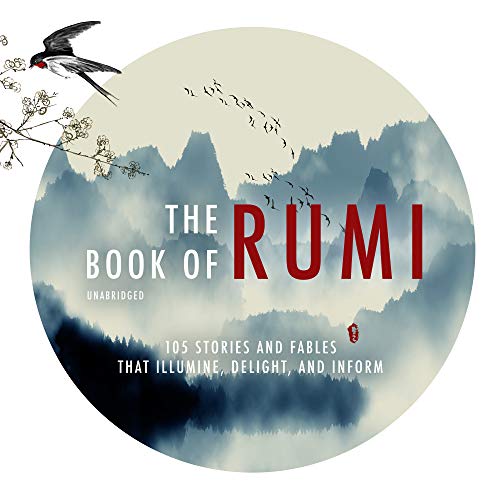
The Book of Rumi by Rumi

The Book of Rumi by Rumi

Regular price
Checking stock...
Regular price
Checking stock...
Proud to be B-Corp

Our business meets the highest standards of verified social and environmental performance, public transparency and legal accountability to balance profit and purpose. In short, we care about people and the planet.

The feel-good place to buy books
  • Free delivery in the UK
  • Supporting authors with AuthorSHARE
  • 100% recyclable packaging
  • B Corp - kinder to people and planet
  • Buy-back with World of Books - Sell Your Books

The Book of Rumi by Rumi

Philip Pullman, author of 'His Dark Materials' trilogy, has remarked that after nourishment, shelter, and companionship, stories are the thing we need most in the world. This new collection of Rumi stories fills that need.

This fresh prose translation of 105 short teaching stories by Rumi, which form the core of the six-volume Masnavi, explores the hidden spiritual aspects of everyday experience. Rumi transforms the seemingly mundane events of daily life into profound Sufi teaching moments. These prose gems open the mystical portal to the world of the ancient mystic.

These stories include well-known and popular tales such as Angel of Death, The Sufi and His Cheating Wife, Moses and the Shepherd, Chickpeas, and The Greek and Chinese Painters as well as the less commonly quoted parables: The Basket Weaver, The Mud Eater, and A Sackful of Pebbles.

Rumi's voice alternates between playful and authoritative, whether he is telling stories of ordinary lives or inviting the discerning reader to higher levels of introspection and attainment of transcendent values. Mafi's translations delicately reflect the nuances of Rumi's poetry while retaining the positive tone of all of Rumi's writings, as well as the sense of suspense and drama that mark the essence of the Masnavi.

Called 'Jelaluddin Balkhi' by the Persians and Afghans, Rumi was born on September 30, 1207, in Balkh, Afghanistan, then a part of the Persian Empire. Between 1215 and 1220, he and his family fled the threat of the invading Mongols and emigrated to Konya, Turkey; it was sometime after this that he became known as 'Rumi' meaning 'from Roman Anatolia'. His father, Bahauddin Walad, was a theologian and a mystic, and after his death Rumi took over the role of sheikh in the dervish learning community in Konya. Rumi pursued the life of an orthodox religious scholar until 1244 when he encountered the wandering dervish, Shams of Tabriz. After an exchange of religious ideas Shams and Rumi became inseparable friends, transported into a world of pure, mystical, conversation. This intense relationship left Rumi's students feeling neglected, and, feeling the ill-will, Shams disappeared. After news of Shams came from Damascus, Rumi's son was sent to bring him back, and the mystical conversation, or sohbet, began again. After Shams' second disappearance (he was probably murdered), and a period spent searching for his lost friend, Rumi came to the conclusion that Shams was now a part of him. Further concluding that when he wrote poetry it was Shams writing through him, he called his huge collection of odes and quatrains The Works of Shams of Tabriz. Following Shams' death Rumi had two other mystical companions, firstly Saladin Zarkub, a goldsmith, and then, after Saladin's death, Husam Chelebi, Rumi's scribe and student. It was Husam that Rumi declared the source of his vast six-volume masterwork Mathnawi. After twelve years of work on this masterpiece Rumi died on December 17, 1273.
Colemam Barks taught poetry and creative writing at the University of Georgia for thirty years and has been a student of Sufism since 1977. The translator of numerous Rumi works, his work with the poet was featured in an hour-long segment in Bill Moyers's Language of Life series. He lives in Athens, Georgia.
SKU Nicht verfügbar
EAN 9781982529444
Titel The Book of Rumi
Veröffentlichungsdatum 2018-11-01
Format Audiobook Unabridged
Studio Blackstone Pub
Buchzustand Nicht verfügbar
Hinweis Nicht verfügbar
By (author) Rumi
Translated by Maryam Mafi
Foreword by Narguess Farzad