
Common Sense and Other Writings


Proud to be B-Corp
The feel-good place to buy books
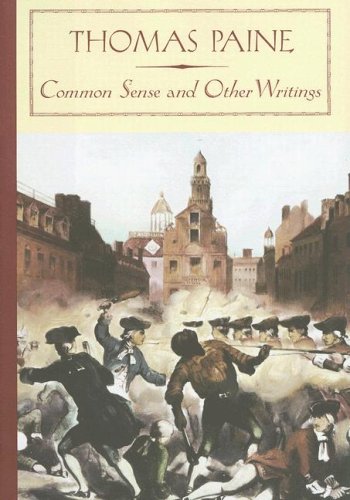
Common Sense and Other Writings by Thomas Paine
Common Sense and Other Writings, by Thomas Paine, is part of the Barnes & Noble Classicsseries, which offers quality editions at affordable prices to the student and the general reader, including new scholarship, thoughtful design, and pages of carefully crafted extras. Here are some of the remarkable features of Barnes & Noble Classics- New introductions commissioned from today's top writers and scholars
- Biographies of the authors
- Chronologies of contemporary historical, biographical, and cultural events
- Footnotes and endnotes
- Selective discussions of imitations, parodies, poems, books, plays, paintings, operas, statuary, and films inspired by the work
- Comments by other famous authors
- Study questions to challenge the reader's viewpoints and expectations
- Bibliographies for further reading
- Indices & Glossaries, when appropriate
In later works, such as The Rights of Man, The Age of Reason, and other selections included in this volume, Paine proved himself a visionary moralist centuries ahead of his time. He believed that every human has the natural right to life s necessities and that government s role should be to provide for those in dire need. An impassioned opponent of all forms of slavery, he understood that no one in poverty is truly free, a lesson still to be learned by many of our leaders today.Joyce Appleby, Professor Emerita at the University of California, Los Angeles, has followed the trajectory of American nation-building in her books Capitalism and a New Social Order: The Republican Vision of the 1790s, Inheriting the Revolution: The First Generation of Americans, Thomas Jefferson, and A Restless Past: History and the American Public.
Paine, Thomas: - Thomas Paine (February 9, 1737 [O.S. January 29, 1736]- June 8, 1809) was an English-born American political activist, philosopher, political theorist, and revolutionary. He authored Common Sense (1776) and The American Crisis (1776-1783), the two most influential pamphlets at the start of the American Revolution, and helped inspire the patriots in 1776 to declare independence from Great Britain. His ideas reflected Enlightenment-era ideals of transnational human rights. Historian Saul K. Padover described him as a corsetmaker by trade, a journalist by profession, and a propagandist by inclination. Born in Thetford in the English county of Norfolk, Paine migrated to the British American colonies in 1774 with the help of Benjamin Franklin, arriving just in time to participate in the American Revolution. Virtually every rebel read (or listened to a reading of) his powerful pamphlet Common Sense, proportionally the all-time best-selling American title, which catalysed the rebellious demand for independence from Great Britain. Common Sense was so influential that John Adams said: Without the pen of the author of Common Sense, the sword of Washington would have been raised in vain. The American Crisis was a pro-revolutionary pamphlet series. Paine lived in France for most of the 1790s, becoming deeply involved in the French Revolution. He wrote Rights of Man (1791), in part a defence of the French Revolution against its critics. His attacks on Anglo-Irish conservative writer Edmund Burke led to a trial and conviction in absentia in England in 1792 for the crime of seditious libel. The British government of William Pitt the Younger, worried by the possibility that the French Revolution might spread to England, had begun suppressing works that espoused radical philosophies. Paine's work, which advocated the right of the people to overthrow their government, was duly targeted, with a writ for his arrest issued in early 1792. Paine fled to France in September where, despite not being able to speak French, he was quickly elected to the French National Convention. The Girondists regarded him as an ally. Consequently, the Montagnards, especially Maximilien Robespierre, regarded him as an enemy. In December 1793, he was arrested and was taken to Luxembourg Prison in Paris. While in prison, he continued to work on The Age of Reason (1793-1794). James Monroe, a future President of the United States, used his diplomatic connections to get Paine released in November 1794. Paine became notorious because of his pamphlets. In The Age of Reason he advocated deism, promoted reason and free thought and argued against institutionalized religion in general and Christian doctrine in particular. He published the pamphlet Agrarian Justice (1797), discussing the origins of property and introduced the concept of a guaranteed minimum income through a one-time inheritance tax on landowners. In 1802, he returned to the U.S. When he died on June 8, 1809, only six people attended his funeral as he had been ostracized for his ridicule of Christianity.
| SKU | Nicht verfügbar |
| ISBN 13 | 9781593083762 |
| ISBN 10 | 1593083769 |
| Titel | Common Sense and Other Writings |
| Autor | Thomas Paine |
| Serie | Barnes And Noble Classics |
| Buchzustand | Nicht verfügbar |
| Bindungsart | Hardback |
| Verlag | Barnes & Noble |
| Erscheinungsjahr | 2005-11-01 |
| Seitenanzahl | 394 |
| Hinweis auf dem Einband | Die Abbildung des Buches dient nur Illustrationszwecken, die tatsächliche Bindung, das Cover und die Auflage können sich davon unterscheiden. |
| Hinweis | Nicht verfügbar |