
Data-Driven Science and Engineering


Zusammenfassung
The feel-good place to buy books
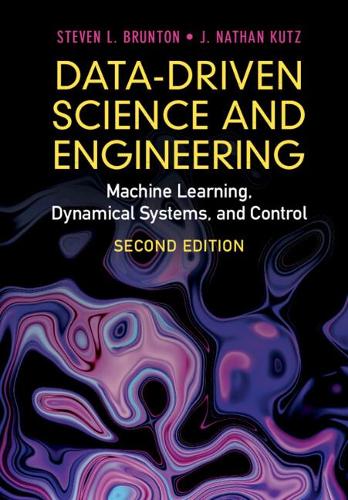
Data-Driven Science and Engineering by Steven L Brunton
Data-driven discovery is revolutionizing how we model, predict, and control complex systems. Now with Python and MATLAB(R), this textbook trains mathematical scientists and engineers for the next generation of scientific discovery by offering a broad overview of the growing intersection of data-driven methods, machine learning, applied optimization, and classical fields of engineering mathematics and mathematical physics. With a focus on integrating dynamical systems modeling and control with modern methods in applied machine learning, this text includes methods that were chosen for their relevance, simplicity, and generality. Topics range from introductory to research-level material, making it accessible to advanced undergraduate and beginning graduate students from the engineering and physical sciences. The second edition features new chapters on reinforcement learning and physics-informed machine learning, significant new sections throughout, and chapter exercises. Online supplementary material - including lecture videos per section, homeworks, data, and code in MATLAB(R), Python, Julia, and R - available on databookuw.com.
'Finally, a book that introduces data science in a context that will make any mechanical engineer feel comfortableData science is the new calculus, and no engineer should graduate without a thorough understanding of the topic.' Hod Lipson, Columbia University
'This book is a must-have for anyone interested in data-driven modeling and simulations. The readers as diverse as undergraduate STEM students and seasoned researchers would find it useful as a guide to this rapidly evolving field. Topics covered by the monograph include dimension reduction, machine learning, and robust control of dynamical systems with uncertain/random inputs. Every chapter contains codes and homework problems, which make this treaties ideal for the classroom setting. The book is supplemented with online lectures, which are not only educational but also entertaining to watch.' Daniel M. Tartakovsky, Stanford University
'Engineering principles will always be based on physics, and the models that underpin engineering will be derived from these physical laws. But in the future models based on relationships in large datasets will be as important and, when used alongside physics-based models, will lead to new insights and designs. Brunton and Kutz will equip students and practitioners with the tools they will need for this exciting future.' Greg Hyslop, Boeing
'Brunton and Kutz's book is fast becoming an indispensable resource for machine learning and data-driven learning in science and engineering. The second edition adds several timely topics in this lively field, including reinforcement learning and physics-informed machine learning. The text balances theoretical foundations and concrete examples with code, making it accessible and practical for students and practitioners alike.' Tim Colonius, California Institute of Technology
'This is a must read for those who are interested in understanding what machine learning can do for dynamical systems! Steve and Nathan have done an excellent job in bringing everyone up to speed to the modern application of machine learning on these complex dynamical systems.' Shirley Ho, Flatiron Institute/New York University
'This book is a must-have for anyone interested in data-driven modeling and simulations. The readers as diverse as undergraduate STEM students and seasoned researchers would find it useful as a guide to this rapidly evolving field. Topics covered by the monograph include dimension reduction, machine learning, and robust control of dynamical systems with uncertain/random inputs. Every chapter contains codes and homework problems, which make this treaties ideal for the classroom setting. The book is supplemented with online lectures, which are not only educational but also entertaining to watch.' Daniel M. Tartakovsky, Stanford University
'Engineering principles will always be based on physics, and the models that underpin engineering will be derived from these physical laws. But in the future models based on relationships in large datasets will be as important and, when used alongside physics-based models, will lead to new insights and designs. Brunton and Kutz will equip students and practitioners with the tools they will need for this exciting future.' Greg Hyslop, Boeing
'Brunton and Kutz's book is fast becoming an indispensable resource for machine learning and data-driven learning in science and engineering. The second edition adds several timely topics in this lively field, including reinforcement learning and physics-informed machine learning. The text balances theoretical foundations and concrete examples with code, making it accessible and practical for students and practitioners alike.' Tim Colonius, California Institute of Technology
'This is a must read for those who are interested in understanding what machine learning can do for dynamical systems! Steve and Nathan have done an excellent job in bringing everyone up to speed to the modern application of machine learning on these complex dynamical systems.' Shirley Ho, Flatiron Institute/New York University
J. Nathan Kutz, Professor of Applied Mathematics, University of Washington Professor Kutz is the Robert Bolles and Yasuko Endo Professor of Applied Mathematics at the University of Washington. Prof. Kutz was awarded the B.S. in physics and mathematics from the University of Washington (Seattle, WA) in 1990 and the PhD in Applied Mathematics from Northwestern University
(Evanston, IL) in 1994. He joined the Department of Applied Mathematics, University of Washington in 1998 and became Chair in 2007. Professor Kutz is especially interested in a unified approach to applied mathematics that includes modeling, computation and analysis. His area of current interest concerns phenomena in complex systems and data analysis (dimensionality reduction, compressive sensing, machine learning), neuroscience
(neuro-sensory systems, networks of neurons), and the optical sciences (laser dynamics and modelocking, solitons, pattern formation in nonlinear optics).
| SKU | Nicht verfügbar |
| ISBN 13 | 9781009098489 |
| ISBN 10 | 1009098489 |
| Titel | Data-Driven Science and Engineering |
| Autor | Steven L Brunton |
| Buchzustand | Nicht verfügbar |
| Bindungsart | Hardback |
| Verlag | Cambridge University Press |
| Erscheinungsjahr | 2022-05-05 |
| Seitenanzahl | 614 |
| Hinweis auf dem Einband | Die Abbildung des Buches dient nur Illustrationszwecken, die tatsächliche Bindung, das Cover und die Auflage können sich davon unterscheiden. |
| Hinweis | Nicht verfügbar |