
Diagnosing Learning Disorders, Second Edition


Zusammenfassung
The feel-good place to buy books
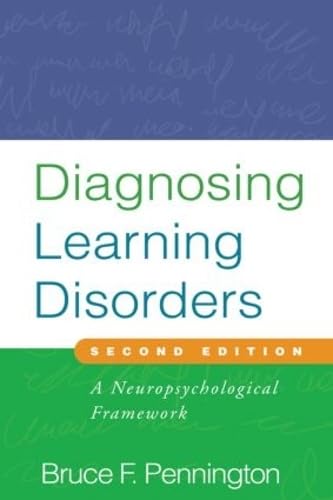
Diagnosing Learning Disorders, Second Edition by Bruce F Pennington
From a trusted expert in the field, this authoritative work provides an accessible overview of what learning disorders are, how they develop, and how to diagnose and treat them effectively. The author presents the most current neuroscientific knowledge on a range of conditions, including dyslexia, autism spectrum disorders, attention-deficit/hyperactivity disorder, and others. Practitioners gain vital insights and tools for making sense of children's impairments and strengths, collecting and interpreting diagnostic data from a variety of sources, and linking diagnosis to evidence-based interventions. The second edition has been substantially revised and expanded to reflect significant clinical and research advances. New to This Edition *Covers additional disorders: intellectual disability, mathematics disorder, and developmental coordination disorder, plus a chapter on less well-validated disorders. *New case illustrations and a focus on empirically based practice. *Now grounded in a multiple cognitive-deficit model of learning disorders, replacing the prior edition's modular, single-deficit model. *An illuminating chapter on controversial therapies separates myths from facts."Pennington provides an excellent overview of both theoretical and intervention aspects of learning disordersThis second edition examines learning disorders from a multifaceted view and provides detailed accounts of the assessment and intervention procedures needed to help individuals with these disorders. This book should be required reading for special education and school psychology professionals, as well as graduate students. Pennington should be commended for producing such an authoritative volume."--R. Malatesha Joshi, PhD, Professor of Literacy Education, ESL, and Educational Psychology, Texas A&M University
"This unique book provides practitioners with a comprehensive picture of the broad array of conditions subsumed under the term 'learning disorders,' including dyslexia, ADHD, speech and language difficulties, autism spectrum disorder, and intellectual disabilities. For those who work with persons with learning disorders or who want to know more about this extremely complex subject, the second edition of Diagnosing Learning Disorders is a 'must read.'"--Steve Graham, EdD, Peabody College of Education, Vanderbilt University
"In this second edition, Pennington captures the latest research and theories about learning disorders in a way that will be readily understandable for clinicians, scientists, educators, and graduate students. He cogently explains how the field has developed, thus providing a broader context for the new research that is covered. Extremely well written, and comprehensive in scope, this volume integrates information from clinical practice, cognitive neuroscience, and molecular biology. It is destined to be the authoritative reference on learning disorders."--Geraldine Dawson, PhD, Chief Science Officer, Autism Speaks, Inc., and Department of Psychiatry, University of North Carolina, Chapel Hill
"Superb. A 'must' for educators, psychologists, and others who care about learning disorders and want to learn about the very latest scientific knowledge and its implications for clinical practice. Pennington is a trusted expert in learning disorders, one of only a small cadre of distinguished scholar-clinicians who not only know and create the science, but also work closely with children and adults who are affected. Here, theory and practice are linked in a scientifically rigorous and highly readable and relevant volume."--Sally E. Shaywitz, MD, Audrey G. Ratner Professor in Learning Development, Yale University School of Medicine; Co-Director, Yale Center for Dyslexia and Creativity; author of Overcoming Dyslexia
"I am grateful to Pennington for this updated and expanded second edition....Especially useful are the authoritative, lucid discussions of controversial diagnostic entities and therapeutic approaches."--Martha Bridge Denckla, MD, Batza Family Endowed Chair and Director, Developmental Cognitive Neurology Clinic, Kennedy Krieger Institute
"This updated work has been eagerly awaited. Pennington provides a basic understanding of the most common learning disorders, complete with the latest genetic and neuroscientific knowledge and clear examples of clinical presentations. In the second edition, the review of unproven therapies is novel and will surely prove useful to clinicians, who are frequently asked by families about these treatments. This book will become a classic for graduate students and practitioners in pediatric neuropsychology, child clinical psychology, and educational psychology."--Deborah Waber, PhD, Department of Psychiatry, Harvard Medical School, Children's Hospital Boston
"This updated work has been eagerly awaited. Pennington provides a basic understanding of the most common learning disorders, complete with the latest genetic and neuroscientific knowledge and clear examples of clinical presentations. In the second edition, the review of unproven therapies is novel and will surely prove useful to clinicians, who are frequently asked by families about these treatments. This book will become a classic for graduate students and practitioners in pediatric neuropsychology, child clinical psychology, and educational psychology." - Deborah Waber, Department of Psychiatry, Harvard Medical School, Children's Hospital Boston, USA
"Superb. A 'must' for educators, psychologists, and others who care about learning disabilities and want to learn about the very latest scientific knowledge and its implications for clinical practice. Pennington is a trusted expert in learning disabilities, one of only a small cadre of distinguished scholar-clinicians who not only know and create the science, but also work closely with children and adults who are affected. Here, theory and practice are linked in a scientifically rigorous and highly readable and relevant volume." - Sally E. Shaywitz, Audrey G. Ratner Professor in Learning Development, Yale University School of Medicine; Co-Director, Yale Center for Dyslexia and Creativity; author of Overcoming Dyslexia, USA
"I am grateful to Pennington for this updated and expanded second edition….Especially useful are the authoritative, lucid discussions of controversial diagnostic entities and therapeutic approaches." - Martha Bridge Denckla, Batza Family Endowed Chair and Director, Developmental Cognitive Neurology Clinic, Kennedy Krieger Institute, USA
"In this second edition, Pennington captures the latest research and theories about learning disorders in a way that will be readily understandable for clinicians, scientists, educators, and graduate students. He cogently explains how the field has developed, thus providing a broader context for the new research that is covered. Extremely well written, and comprehensive in scope, this volume integrates information from clinical practice, cognitive neuroscience, and molecular biology. It is destined to be the authoritative reference on learning disorders." - Geraldine Dawson, Chief Science Officer, Autism Speaks, Inc., and Department of Psychiatry, University of North Carolina, Chapel Hill, USA
"This unique book provides practitioners with a comprehensive picture of the broad array of conditions subsumed under the term 'learning disorders,' including dyslexia, ADHD, speech and language difficulties, autism spectrum disorder, and intellectual disabilities. For those who work with persons with learning disorders or who want to know more about this extremely complex subject, the second edition of Diagnosing Learning Disorders is a 'must read.'" - Steve Graham, Peabody College of Education, Vanderbilt University, USA
"Pennington provides an excellent overview of both theoretical and intervention aspects of learning disorders. This second edition examines learning disorders from a multifaceted view and provides detailed accounts of the assessment and intervention procedures needed to help individuals with these disorders. This book should be required reading for special education and school psychology professionals, as well as graduate students. Pennington should be commended for producing such an authoritative volume." - R. Malatesha Joshi, Professor of Literacy Education, ESL, and Educational Psychology, Texas A&M University, USA
"Compelling because of the author's major contributions and long active presence in the field. His experience uniquely enables him to integrate the past with present research findings and practice....Can be utilized by practitioners (pediatricians, psychologists, therapists), researchers, and students to understand 'the latest' in the burgeoning literature on learning disorders, including autism. The user can quickly look up a disorder, find the clinical description and comorbidities, learn about the candidate genes, and how the disorder has been characterized via neuroimaging and neuropsychological studies....Compared to other books in this field, this book offers more evidence based interventions (when available) for the individual disorders. I recommend this for the intended audience (practitioners, researchers, and students), and also for already informed parents who wish to learn more about their child's condition." - Deborah K. Sokol, Journal of Autism and Developmental Disorders, Vol. 40, No. 9, September 2010
Bruce F. Pennington, PhD, is a developmental neuropsychologist who has earned an international reputation for his research on dyslexia, attention-deficit/hyperactivity disorder, and autism. He has published 163 articles in refereed journals and was selected to appear on ISIHighlyCited.com because of his exceptional citation count in the field of Psychology/Psychiatry. He is particularly interested in using genetic and neuropsychological methods to understand comorbidity among disorders. Dr. Pennington is a John Evans Professor of Psychology at the University of Denver, where he heads the Developmental Cognitive Neuroscience Program. His honors include Research Scientist, MERIT, and Fogarty awards from the National Institutes of Health; the Samuel T. Orton Award from the International Dyslexia Association; and the Emanuel Miller Memorial Lecture from the British Association for Child and Adolescent Mental Health. He is also a Fellow of the American Association for the Advancement of Science. In addition to being a researcher and research mentor, Dr. Pennington is also a child clinical neuropsychologist, and has been active in clinical practice and training throughout his career.
| SKU | Nicht verfügbar |
| ISBN 13 | 9781593857141 |
| ISBN 10 | 1593857144 |
| Titel | Diagnosing Learning Disorders, Second Edition |
| Autor | Pennington Bruce F |
| Buchzustand | Nicht verfügbar |
| Bindungsart | Hardback |
| Verlag | The Guilford Press |
| Erscheinungsjahr | 2008-11-24 |
| Seitenanzahl | 355 |
| Hinweis auf dem Einband | Die Abbildung des Buches dient nur Illustrationszwecken, die tatsächliche Bindung, das Cover und die Auflage können sich davon unterscheiden. |
| Hinweis | Nicht verfügbar |