
Goethe's Theory of Knowledge


Proud to be B-Corp
The feel-good place to buy books
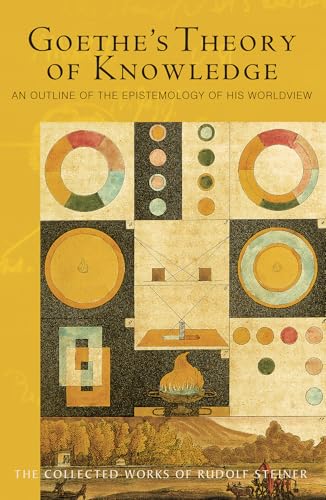
Goethe's Theory of Knowledge by Rudolf Steiner
Written 1884-1885; first published 1886 (CW 2)As the editor of Goethe's scientific writings during the 1880s, Rudolf Steiner became immersed in a worldview that paralleled and amplified his own views in relation to epistemology, the interface between science and philosophy, the theory of how we know the world and ourselves. At the time, like much of the thinking today and the foundation of modern natural science, the predominant theories held that individual knowledge is limited to thinking that reflects objective, sensory perception. Steiner's view was eventually distilled in his Anthroposophical Leading Thoughts in 1924:
There are those who believe that, with the limits of knowledge derived from sensory perception, the limits of all insight are given. Yet if they would carefully observe how they become conscious of these limits, they would find in the very consciousness of the limits the faculties to transcend them.
In this concise volume, Steiner lays out his argument for this view and, moreover, begins his explication of how one goes beyond thinking to the observation of thinking itself. Goethe's Theory of Knowledge is essential reading for a deeper understanding of Rudolf Steiner's seminal work, Intuitive Thinking as a Spiritual Path: A Philosophy of Freedom.
CONTENTS:
- Introduction by Christopher Bamford
- Preface to the Edition of 1924 by Rudolf Steiner
- Foreword to the First Edition (1886) by Rudolf Steiner
- A. Preliminary Questions
- 1. The Point of Departure
- 2. Goethe's Science According to Schiller's Method
- 3. The Purpose of Our Science
- B. Experience
- 4. Establishing the Concept of Experience
- 5. Examining the Essence of Experience
- 6. Correcting the Erroneous View of Experience as a Totality
- 7. The Experience of Each Individual Reader
- C. Thinking
- 8. Thinking as a Higher Experience within Experience
- 9. Thinking and Consciousness
- 10. The Inner Nature of Thinking
- D. Knowledge
- 11. Thought and Perception
- 12. Intellect and Reason
- 13. The Act of Cognition
- 14. Cognition and the Ultimate Ground of Things
- E. Knowing Nature
- 15. Inorganic Nature
- 16. Organic Nature
- F. The Humanities
- 17. Introduction: Mind and Nature
- 18. Psychological Cognition
- 19. Human Freedom
- 20. Optimism and Pessimism
- G. Conclusion
- 21. Knowledge and Artistic Creation
- Notes to the First Edition 1886]
- Annotations to the Edition of 1924
A Theory of Knowledge is a translation from the German of Grundlinien einer Erkenntnistheorie der Goetheschen Weltanschauung, mit besonderer R cksicht auf Schiller (GA 2). Previous translations were published as The Science of Knowing (1988) and The Theory of Knowledge implicit in Goethe's World-Conception: Fundamental Outlines with Special Reference to Schiller (1940).
Many volumes by Rudolf Steiner on Anthroposophy and Waldorf education have been translated by Robert F. Lathe.
| SKU | Nicht verfügbar |
| ISBN 13 | 9780880106238 |
| ISBN 10 | 0880106239 |
| Titel | Goethe's Theory of Knowledge |
| Autor | Rudolf Steiner |
| Buchzustand | Nicht verfügbar |
| Bindungsart | Paperback |
| Verlag | Anthroposophic Press Inc |
| Erscheinungsjahr | 2008-11-01 |
| Seitenanzahl | 156 |
| Hinweis auf dem Einband | Die Abbildung des Buches dient nur Illustrationszwecken, die tatsächliche Bindung, das Cover und die Auflage können sich davon unterscheiden. |
| Hinweis | Nicht verfügbar |