
How Democracies Die


Proud to be B-Corp
The feel-good place to buy books
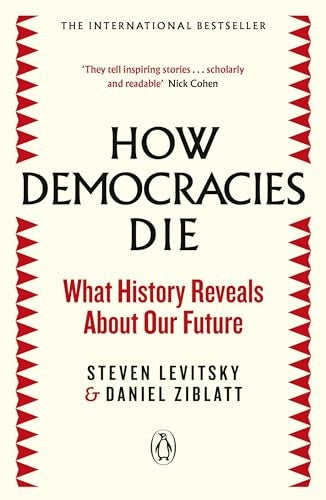
How Democracies Die by Steven Levitsky
'The most important book of the Trump era' The Economist How does a democracy die? What can we do to save our own? What lessons does history teach us? In the 21st century democracy is threatened like never before. Drawing insightful lessons from across history - from Pinochet's murderous Chilean regime to Erdogan's quiet dismantling in Turkey - Levitsky and Ziblatt explain why democracies fail, how leaders like Trump subvert them today and what each of us can do to protect our democratic rights. 'This book looks to history to provide a guide for defending democratic norms when they are under threat, and finds that it is possible to fight back.' David Runciman 'A useful primer on the importance of norms, institutional restraints and civic participation in maintaining a democracy - and how quickly those things can erode when we're not paying attention' President Barack Obama 'A must-read' Andrew Marr, Sunday Times 'The greatest of the many merits of Levitsky and Ziblatt's How Democracies Die is their rejection of western exceptionalism. They tell inspiring stories I had not heard before' Nick Cohen, Observer 'Provocative, timely. One of my favourite reads this year' Elif Shafak 'Anyone who is concerned about the future of democracy should read this brisk, accessible book. Anyone who is not concerned should definitely read it' Daron Acemoglu, co-author of Why Nations FailHow Democracies Die by Steven Levitsky and Daniel Ziblatt is a useful primer on the importance of norms, institutional restraints and civic participation in maintaining a democracy - and how quickly those things can erode when we're not paying attention * President Barack Obama *
With great energy and integrity [Levitsky and Ziblatt] apply their expertise to the current problems of the United States. -- Timothy Snyder, author of On Tyranny
We owe the authors a debt of thanks for bringing their deep understanding to bear on the central political issue of the day. -- Francis Fukuyama, author of Political Order and Political Decay
What's the worst thing to happen to US democracy recently? Most answers to that question start and end with Donald Trump. Steven Levitsky and Daniel Ziblatt, though as horrified by Trump as anyone, try to take a wider view. This book looks to history to provide a guide for defending democratic norms when they are under threat, and finds that it is possible to fight back. Provocative and readable. -- David Runciman * The Guardian *
There are two must-read books about the Trump presidency at the moment. This is the one you probably haven't heard of. It is also the one that is most useful to British readers. Steven Levitsky and Daniel Ziblatt are anti-Donald Trump politics professors at Harvard. And the big advantage of political scientists over even the shrewdest and luckiest of eavesdropping journalists is that they have the training to give us a bigger picture.
They set out some rules about the slow, internal collapse of democracies, which are entirely relevant to Britain...
The greatest of the many merits of Steven Levitsky and Daniel Ziblatt's contribution to what will doubtless be the ballooning discipline of democracy death studies is their rejection of western exceptionalism. They tell inspiring stories I had not heard before...excellent, scholarly and readable, alarming and level-headed. * The Guardian *
The political-science text in vogue this winter is How Democracies Die. * The New Yorker *
[An] important new book. * New York Times *
Levitsky and Ziblatt show how democracies have collapsed elsewhere-not just through violent coups, but more commonly (and insidiously) through a gradual slide into authoritarianism.... How Democracies Die is a lucid and essential guide to what can happen here. * New York Times *
We're already awash in public indignation-what we desperately need is a sober, dispassionate look at the current state of affairs. Steven Levitsky and Daniel Ziblatt, two of the most respected scholars in the field of democracy studies, offer just that. * The Washington Post *
Grander, more didactic ambitions underpin "How Democracies Die" ... a more scholarly approach * The Economist *
The most thought-provoking book comparing democratic crises in different nations * New York Review of Books *
The most important book of the Trump era was not Bob Woodward's Fear or Michael Wolff's Fire and Fury or any of the other bestselling exposés of the White House circus. Arguably it was a wonkish tome by two Harvard political scientists, Steven Levitsky and Daniel Ziblatt, published a year into Donald Trump's presidency and entitled How Democracies Die
* The Economist *| SKU | Nicht verfügbar |
| ISBN 13 | 9780241381359 |
| ISBN 10 | 0241381355 |
| Titel | How Democracies Die |
| Autor | Steven Levitsky |
| Buchzustand | Nicht verfügbar |
| Bindungsart | Paperback |
| Verlag | Penguin Books Ltd |
| Erscheinungsjahr | 2019-01-03 |
| Seitenanzahl | 320 |
| Hinweis auf dem Einband | Die Abbildung des Buches dient nur Illustrationszwecken, die tatsächliche Bindung, das Cover und die Auflage können sich davon unterscheiden. |
| Hinweis | Nicht verfügbar |