
How Students Learn


How Students Learn
Regular price
Checking stock...
Regular price
Checking stock...
Zusammenfassung
Building on the discoveries detailed in the bestselling "How People Learn", this book explores how the principles of learning can be applied in teaching history, science, and math topics at three levels: elementary, middle, and high school. It also features illustrated suggestions for classroom activities.
The feel-good place to buy books
- Free delivery in the UK
- Supporting authors with AuthorSHARE
- 100% recyclable packaging
- B Corp - kinder to people and planet
- Buy-back with World of Books - Sell Your Books
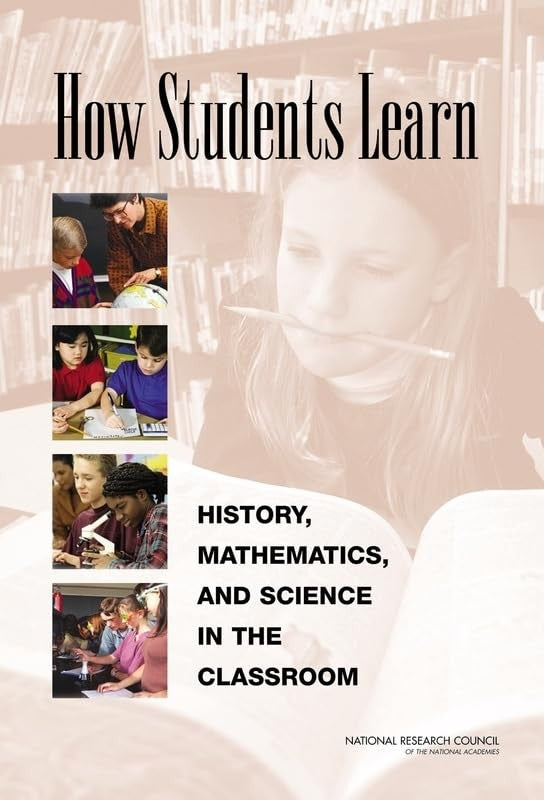
How Students Learn by National Research Council
How do you get a fourth-grader excited about history? How do you even begin to persuade high school students that mathematical functions are relevant to their everyday lives? In this volume, practical questions that confront every classroom teacher are addressed using the latest exciting research on cognition, teaching, and learning. How Students Learn: History, Mathematics, and Science in the Classroom builds on the discoveries detailed in the bestselling How People Learn. Now, these findings are presented in a way that teachers can use immediately, to revitalize their work in the classroom for even greater effectiveness. Organized for utility, the book explores how the principles of learning can be applied in teaching history, science, and math topics at three levels: elementary, middle, and high school. Leading educators explain in detail how they developed successful curricula and teaching approaches, presenting strategies that serve as models for curriculum development and classroom instruction. Their recounting of personal teaching experiences lends strength and warmth to this volume. The book explores the importance of balancing students' knowledge of historical fact against their understanding of concepts, such as change and cause, and their skills in assessing historical accounts. It discusses how to build straightforward science experiments into true understanding of scientific principles. And it shows how to overcome the difficulties in teaching math to generate real insight and reasoning in math students. It also features illustrated suggestions for classroom activities. How Students Learn offers a highly useful blend of principle and practice. It will be important not only to teachers, administrators, curriculum designers, and teacher educators, but also to parents and the larger community concerned about children's education. Table of Contents Front Matter 1 Introduction Part I HISTORY - 2 Putting Principles into Practice: Understanding History 3 Putting Principles into Practice: Teaching and Planning 4 They Thought the World Was Flat? Applying the Principles of How People Learn in Teaching High School History Part II MATHEMATICS- 5 Mathematical Understanding: An Introduction 6 Fostering the Development of Whole-Number Sense: Teaching Mathematics in the Primary Grades 7 Pipes, Tubes, and Beakers: New Approaches to Teaching the Rational-Number System 8 Teaching and Learning Functions Part III SCIENCE - 9 Scientific Inquiry and How People Learn 10 Teaching to Promote the Development of Scientific Knowledge and Reasoning About Light at the Elementary School Level 11 Guided Inquiry in the Science Classroom 12 Developing Understanding Through Model-Based Inquiry A FINAL SYNTHESIS: REVISITING THE THREE LEARNING PRINCIPLES - 13 Pulling Threads Biographical Sketches of Committee Members and Contributors Index
Committee on How People Learn, A Targeted Report for Teachers, Center for Studies on Behavior and Development, National Research Council
| SKU | Nicht verfügbar |
| ISBN 13 | 9780309074339 |
| ISBN 10 | 0309074339 |
| Titel | How Students Learn |
| Autor | National Research Council |
| Buchzustand | Nicht verfügbar |
| Bindungsart | Hardback |
| Verlag | National Academies Press |
| Erscheinungsjahr | 2005-01-23 |
| Seitenanzahl | 632 |
| Hinweis auf dem Einband | Die Abbildung des Buches dient nur Illustrationszwecken, die tatsächliche Bindung, das Cover und die Auflage können sich davon unterscheiden. |
| Hinweis | Nicht verfügbar |