
Information and Self-Organization


Zusammenfassung
The feel-good place to buy books
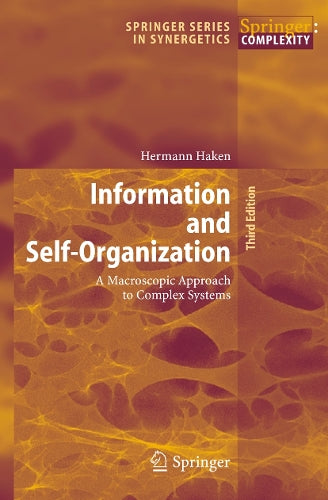
Information and Self-Organization by Hermann Haken
The widespread interest this book has found among professors, scientists and stu dents working in a variety of fields has made a new edition necessary. I have used this opportunity to add three new chapters on recent developments. One of the most fascinating fields of modern science is cognitive science which has become a meet ing place of many disciplines ranging from mathematics over physics and computer science to psychology. Here, one of the important links between these fields is the concept of information which, however, appears in various disguises, be it as Shan non information or as semantic information (or as something still different). So far, meaning seemed to be exorcised from Shannon information, whereas meaning plays a central role in semantic (or as it is sometimes called "pragmatic") information. In the new chapter 13 it will be shown, however, that there is an important interplay between Shannon and semantic information and that, in particular, the latter plays a decisive role in the fixation of Shannon information and, in cognitive processes, al lows a drastic reduction of that information. A second, equally fascinating and rapidly developing field for mathematicians, computer scientists and physicists is quantum information and quantum computa tion. The inclusion of these topics is a must for any modern treatise dealing with in formation. It becomes more and more evident that the abstract concept of informa tion is inseparably tied up with its realizations in the physical world.From the reviews of the third edition:
"This enlarged edition of Information and Self-Organization addresses the concept of information in depth: ranging ‘from Shannon information, from which all semantics has been exorcised, to the effects of information on receivers and the self-creation of meaning’—that is, toward semantic information …Nevertheless, both the qualitative lessons and quantitative analysis presented in the book … very useful for artificial life researchers." (Mikhail Prokopenko, Artificial Life, Vol. 15, 2009)
Hermann Haken is Professor of the Institute for Theoretical Physics at the University of Stuttgart. He is known as the founder of synergetics. His research has been in nonlinear optics (in particular laser physics), solid state physics, statistical physics, and group theory. After the implementation of the first laser in 1960, Professor Haken developed his institute to an international center for laser theory. The interpretation of the laser principles as self organization of non equilibrium systems paved the way to the development of synergetics, of which Haken is recognized as the founder. Hermann Haken has been visiting professor or guest scientist in England, France, Japan, USA, Russia, and China. He is the author of some 23 textbooks and monographs that cover an impressive number of topics from laser physics to synergetics, and editor of a book series in synergetics. For his pathbreaking work and his influence on academic research, he has been awarded many-times. Among others, he is member of the Order Pour le merite and received the Max Planck Medal in 1990.
Paul Levi is Full Professor for Informatics in the Institute for Parallel and Distributed Systems of the University of Stuttgart, Germany. He graduated in physics and computer science and became a senior research scientist in informatics and robotics, and Head of the Department of Technical Expert Systems and Robotics at the University of Karlsruhe. In 1988 he was appointed Professor at the Technical University of Munich, and scientific member of the Bavarian Center for Knowledge-Based Systems. Later on he served as Director of the Institute for Parallel and Distributed High Performance Computers at the University of Stuttgart. He is Member of the Management Board of the Centre for Computer Science (FZI) and Director of the Division Intelligent Systems and Production Engineering (ISPE), Karlsruhe, Germany.
Paul Levi's main research fields include computer vision, robotics, distributed AI and multi-agent systems. He has authored and co-authored both textbooks and monographs.
Paul Levi is Full Professor for Informatics in the Institute for Parallel and Distributed Systems of the University of Stuttgart, Germany. He graduated in physics and computer science and became a senior research scientist in informatics and robotics, and Head of the Department of Technical Expert Systems and Robotics at the University of Karlsruhe. In 1988 he was appointed Professor at the Technical University of Munich, and scientific member of the Bavarian Center for Knowledge-Based Systems. Later on he served as Director of the Institute for Parallel and Distributed High Performance Computers at the University of Stuttgart. He is Member of the Management Board of the Centre for Computer Science (FZI) and Director of the Division Intelligent Systems and Production Engineering (ISPE), Karlsruhe, Germany.
Paul Levi's main research fields include computer vision, robotics, distributed AI and multi-agent systems. He has authored and co-authored both textbooks and monographs.
| SKU | Nicht verfügbar |
| ISBN 13 | 9783642069574 |
| ISBN 10 | 3642069576 |
| Titel | Information and Self-Organization |
| Autor | Hermann Haken |
| Serie | Springer Series In Synergetics |
| Buchzustand | Nicht verfügbar |
| Bindungsart | Paperback |
| Verlag | Springer-Verlag Berlin and Heidelberg GmbH & Co. KG |
| Erscheinungsjahr | 2010-11-25 |
| Seitenanzahl | 258 |
| Hinweis auf dem Einband | Die Abbildung des Buches dient nur Illustrationszwecken, die tatsächliche Bindung, das Cover und die Auflage können sich davon unterscheiden. |
| Hinweis | Nicht verfügbar |