
Introduction to Hidden Semi-Markov Models


Zusammenfassung
The feel-good place to buy books
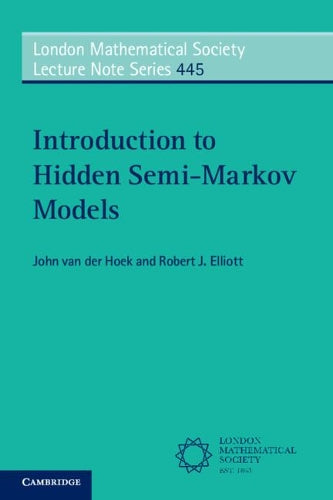
Introduction to Hidden Semi-Markov Models by John Van Der Hoek
Markov chains and hidden Markov chains have applications in many areas of engineering and genomics. This book provides a basic introduction to the subject by first developing the theory of Markov processes in an elementary discrete time, finite state framework suitable for senior undergraduates and graduates. The authors then introduce semi-Markov chains and hidden semi-Markov chains, before developing related estimation and filtering results. Genomics applications are modelled by discrete observations of these hidden semi-Markov chains. This book contains new results and previously unpublished material not available elsewhere. The approach is rigorous and focused on applications.
'… this book is of interest to researchers attracted by hidden Markov and semi-Markov modelsIt covers probabilistic and statistical treatments of the considered topics, and introduces the reader … to possible applications, mainly in genomics. Hence, Ph.D. students and specialists in the area of hidden Markov processes are invited to consider this book as a reference in their activities.' Antonio Di Crescenzo, MathSciNet
'… dedicated mostly to graduate students and providing a rigorous and rather complete mathematical introduction to the theory of hidden Markov models as well as hidden semi-Markov models under main assumption that the hidden process is a finite state Markov chain. The semi-Markov models appear when the assumption that the length of time the chain spends in any state is geometrically distributed is relaxed. The authors carefully construct these processes on the canonical probability space and then derive filters and smoother, as well as the Viterbi estimates. The central role plays the EM Algorithm.' Jerzy Ombach, ZB Math Reviews
'… dedicated mostly to graduate students and providing a rigorous and rather complete mathematical introduction to the theory of hidden Markov models as well as hidden semi-Markov models under main assumption that the hidden process is a finite state Markov chain. The semi-Markov models appear when the assumption that the length of time the chain spends in any state is geometrically distributed is relaxed. The authors carefully construct these processes on the canonical probability space and then derive filters and smoother, as well as the Viterbi estimates. The central role plays the EM Algorithm.' Jerzy Ombach, ZB Math Reviews
John van der Hoek is an Associate Professor at the University of South Australia. He has authored papers in partial differential equations, free boundary value problems, numerical analysis, stochastic analysis, actuarial science and mathematical finance. With Robert Elliott he co-authored Binomial Methods in Finance. Robert J. Elliott is a Research Professor at the University of South Australia. Previously he held positions at universities around the world, including Yale, Oxford, Alberta, Calgary and Adelaide. He has authored nine books, including Mathematics of Financial Markets (2004, with P. E. Kopp) and Stochastic Calculus and Application (1982).
| SKU | Nicht verfügbar |
| ISBN 13 | 9781108441988 |
| ISBN 10 | 110844198X |
| Titel | Introduction to Hidden Semi-Markov Models |
| Autor | John Van Der Hoek |
| Serie | London Mathematical Society Lecture Note Series |
| Buchzustand | Nicht verfügbar |
| Bindungsart | Paperback |
| Verlag | Cambridge University Press |
| Erscheinungsjahr | 2018-02-08 |
| Seitenanzahl | 184 |
| Hinweis auf dem Einband | Die Abbildung des Buches dient nur Illustrationszwecken, die tatsächliche Bindung, das Cover und die Auflage können sich davon unterscheiden. |
| Hinweis | Nicht verfügbar |