
Japan's Policy Trap


Zusammenfassung
The feel-good place to buy books
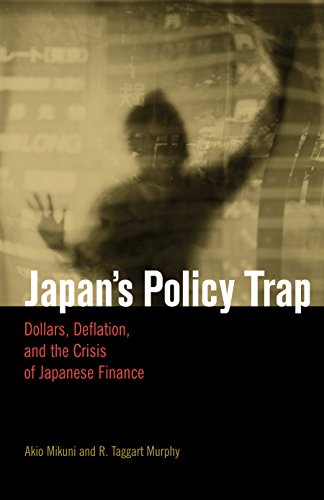
Japan's Policy Trap by Akio Mikuni
Until quite recently, the Japanese inspired a kind of puzzled awe. They had pulled themselves together from the ruin of war, built at breakneck speed a formidable array of export champions, and emerged as the world''s number-two economy and largest net creditor nation. And they did it by flouting every rule of economic orthodoxy. But today only the puzzlement remains--at Japan''s inability to arrest its economic decline, at its festering banking crisis, and at the dithering of its policymakers. Why can''t the Japanese government find the political will to fix the country''s problems? Japan''s Policy Trap offers a provocative new analysis of the country''s protracted economic stagnation. Japanese insider Akio Mikuni and long-term Japan resident R. Taggart Murphy contend that the country has landed in a policy trap that defies easy solution. The authors, who have together spent decades at the heart of Japanese finance, expose the deep-rooted political arrangements that have distorted Japan''s monetary policy in a deflationary direction. They link Japan''s economic difficulties to the Achilles'' heel of the U.S. economy: the U.S. trade and current accounts deficits. For the last twenty years, Japan''s dollar-denominated trade surplus has outstripped official reserves and currency in circulation. These huge accumulated surpluses have long exercised a growing and perverse influence on monetary policy, forcing Japan''s authorities to support a build-up of deflationary dollars. Mikuni and Murphy trace the origins of Japan''s policy trap far back into history, in the measures taken by Japan''s officials to preserve their economic independence in what they saw as a hostile world. Mobilizing every resource to accumulate precious dollars, the authorities eventually found themselves coping with a hoard they could neither use nor exchange. To counteract the deflationary impact, Japanese authorities resorted to the creation of yen liabilities unrelated to production via the largeeflationary direction. They link Japan''s economic difficulties to the Achilles'' heel of the U.S. economy: the U.S. trade and current accounts deficits. For the last twenty years, Japan''s dollar-denominated trade surplus has outstripped official reserves and currency in circulation. These huge accumulated surpluses have long exercised a growing and perverse influence on monetary policy, forcing Japan''s authorities to support a build-up of deflationary dollars. Mikuni and Murphy trace the origins of Japan''s policy trap far back into history, in the measures taken by Japan''s officials to preserve their economic independence in what they saw as a hostile world. Mobilizing every resource to accumulate precious dollars, the authorities eventually found themselves coping with a hoard they could neither use nor exchange. To counteract the deflationary impact, Japanese authorities resorted to the creation of yen liabilities unrelated to production via the largeeflationary direction. They link Japan''s economic difficulties to the Achilles'' heel of the U.S. economy: the U.S. trade and current accounts deficits. For the last twenty years, Japan''s dollar-denominated trade surplus has outstripped official reserves and currency in circulation. These huge accumulated surpluses have long exercised a growing and perverse influence on monetary policy, forcing Japan''s authorities to support a build-up of deflationary dollars. Mikuni and Murphy trace the origins of Japan''s policy trap far back into history, in the measures taken by Japan''s officials to preserve their economic independence in what they saw as a hostile world. Mobilizing every resource to accumulate precious dollars, the authorities eventually found themselves coping with a hoard they could neither use nor exchange. To counteract the deflationary impact, Japanese authorities resorted to the creation of yen liabilities unrelated to production via the largeeflationary direction. They link Japan''s economic difficulties to the Achilles'' heel of the U.S. economy: the U.S. trade and current accounts deficits. For the last twenty years, Japan''s dollar-denominated trade surplus has outstripped official reserves and currency in circulation. These huge accumulated surpluses have long exercised a growing and perverse influence on monetary policy, forcing Japan''s authorities to support a build-up of deflationary dollars. Mikuni and Murphy trace the origins of Japan''s policy trap far back into history, in the measures taken by Japan''s officials to preserve their economic independence in what they saw as a hostile world. Mobilizing every resource to accumulate precious dollars, the authorities eventually found themselves coping with a hoard they could neither use nor exchange. To counteract the deflationary impact, Japanese authorities resorted to the creation of yen liabilities unrelated to production via the largeficulties to the Achilles'' heel of the U.S. economy: the U.S. trade and current accounts deficits. For the last twenty years, Japan''s dollar-denominated trade surplus has outstripped official reserves and currency in circulation. These huge accumulated surpluses have long exercised a growing and perverse influence on monetary policy, forcing Japan''s authorities to support a build-up of deflationary dollars. Mikuni and Murphy trace the origins of Japan''s policy trap far back into history, in the measures taken by Japan''s officials to preserve their economic independence in what they saw as a hostile world. Mobilizing every resource to accumulate precious dollars, the authorities eventually found themselves coping with a hoard they could neither use nor exchange. To counteract the deflationary impact, Japanese authorities resorted to the creation of yen liabilities unrelated to production via the large
Akio Mikuni is one of the most universally respected analysts of the Japanese economy in the global financial community. He is the president and founder of Mikuni & Co. Ltd, Japan's leading independent, investor-supported bond-rating agency. Mikuni was named one of the fifty most influential individuals in Asia by Business Week in 1999. He also has been the subject of profiles in the Financial Times and Fortune. R. Taggart Murphy , a former investment banker, is foreign professor, College of International Studies, Tsukuba University, Japan, and a nonresident senior fellow in the Foreign Policy Studies program at the Brookings Institution. His recent books include The Weight of the Yen: How Denial Imperils America's Future and Ruins an Alliance (W. W. Norton, 1997) and Ugokanu Nihon e no Shohosen ( Prescriptions for a Japan That Is Not Moving ), (Mainichi Shinbunsha, 1998).
| SKU | Nicht verfügbar |
| ISBN 13 | 9780815702221 |
| ISBN 10 | 0815702221 |
| Titel | Japan's Policy Trap |
| Autor | Akio Mikuni |
| Buchzustand | Nicht verfügbar |
| Bindungsart | Hardback |
| Verlag | Rowman & Littlefield |
| Erscheinungsjahr | 2002-08-30 |
| Seitenanzahl | 304 |
| Hinweis auf dem Einband | Die Abbildung des Buches dient nur Illustrationszwecken, die tatsächliche Bindung, das Cover und die Auflage können sich davon unterscheiden. |
| Hinweis | Nicht verfügbar |