
Machine Learning for Signal Processing


Zusammenfassung
The feel-good place to buy books
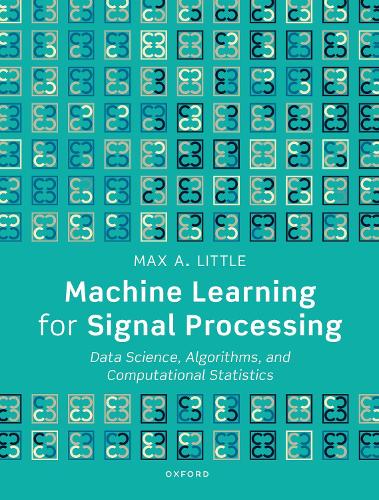
Machine Learning for Signal Processing by Max A Little
This book describes in detail the fundamental mathematics and algorithms of machine learning (an example of artificial intelligence) and signal processing, two of the most important and exciting technologies in the modern information economy. Taking a gradual approach, it builds up concepts in a solid, step-by-step fashion so that the ideas and algorithms can be implemented in practical software applications. Digital signal processing (DSP) is one of the 'foundational' engineering topics of the modern world, without which technologies such the mobile phone, television, CD and MP3 players, WiFi and radar, would not be possible. A relative newcomer by comparison, statistical machine learning is the theoretical backbone of exciting technologies such as automatic techniques for car registration plate recognition, speech recognition, stock market prediction, defect detection on assembly lines, robot guidance, and autonomous car navigation. Statistical machine learning exploits the analogy between intelligent information processing in biological brains and sophisticated statistical modelling and inference. DSP and statistical machine learning are of such wide importance to the knowledge economy that both have undergone rapid changes and seen radical improvements in scope and applicability. Both make use of key topics in applied mathematics such as probability and statistics, algebra, calculus, graphs and networks. Intimate formal links between the two subjects exist and because of this many overlaps exist between the two subjects that can be exploited to produce new DSP tools of surprising utility, highly suited to the contemporary world of pervasive digital sensors and high-powered, yet cheap, computing hardware. This book gives a solid mathematical foundation to, and details the key concepts and algorithms in this important topic.
This book provides an excellent pathway for gaining first-class expertise in machine learningIt provides both the technical background that explains why certain approaches, but not others, are best practice in real world problems, and a framework for how to think about and approach new problems. I highly recommend it for people with a signal processing background who are seeking to become an expert in machine learning. * Alex 'Sandy' Pentland, Toshiba Professor of Media Arts and Sciences, Massachusetts Institute of Technology, *
Over the past decade in signal processing, machine learning has gone from a disparate research field known only to people working on topics such as speech and image processing, to permeating all aspects of it. With this book, Prof. Little has taken an important step in unifying machine learning and signal processing. As a whole, this book covers many topics, new and old, that are important in their own right and equips the reader with a broader perspective than traditional signal processing textbooks. In particular, I would highlight the combination of statistical modeling, convex optimization, and graphs as particularly potent. Machine learning and signal processing are no longer separate, and there is no doubt in my mind that this is the way to teach signal processing in the future. * Mads Christensen, Full Professor in Audio Processing, Aalborg University, Denmark, *
Over the past decade in signal processing, machine learning has gone from a disparate research field known only to people working on topics such as speech and image processing, to permeating all aspects of it. With this book, Prof. Little has taken an important step in unifying machine learning and signal processing. As a whole, this book covers many topics, new and old, that are important in their own right and equips the reader with a broader perspective than traditional signal processing textbooks. In particular, I would highlight the combination of statistical modeling, convex optimization, and graphs as particularly potent. Machine learning and signal processing are no longer separate, and there is no doubt in my mind that this is the way to teach signal processing in the future. * Mads Christensen, Full Professor in Audio Processing, Aalborg University, Denmark, *
Max A. Little is Professor of Mathematics at Aston University, UK, and a world-leading expert in signal processing and machine learning. His research in machine learning for digital health is highly influential and is the basis of advances in basic and applied research into quantifying neurological disorders such as Parkinson disease. He has published over 60 articles in the scientific literature on the topic, two patents, and a textbook. He is an advisor to government and leading international corporations in topics such as machine learning for health.
| SKU | Nicht verfügbar |
| ISBN 13 | 9780198896555 |
| ISBN 10 | 0198896557 |
| Titel | Machine Learning for Signal Processing |
| Autor | Max A Little |
| Buchzustand | Nicht verfügbar |
| Bindungsart | Paperback |
| Verlag | Oxford University Press |
| Erscheinungsjahr | 2024-02-28 |
| Seitenanzahl | 384 |
| Hinweis auf dem Einband | Die Abbildung des Buches dient nur Illustrationszwecken, die tatsächliche Bindung, das Cover und die Auflage können sich davon unterscheiden. |
| Hinweis | Nicht verfügbar |